

DP-100 Exam Dumps Pass with Updated 2026 Certified Exam Questions
DP-100 Exam Questions - Real & Updated Questions PDF
Microsoft DP-100 certification exam is designed to assess the skills and knowledge of data scientists and data engineers in designing and implementing data science solutions using Microsoft Azure technologies. Designing and Implementing a Data Science Solution on Azure certification is ideal for professionals who are looking to enhance their career in the field of data science and want to demonstrate their expertise in designing and implementing data science solutions on Azure.
The DP-100 exam covers a wide range of topics such as data exploration and preparation, modeling, feature engineering, and optimization, among others. Candidates who pass this certification exam demonstrate their expertise in designing and implementing data science solutions using Azure services such as Azure Machine Learning, Azure Databricks, and Azure Stream Analytics. Passing the DP-100 exam is a significant achievement for data scientists and can open up numerous career opportunities in the field of data science.
NEW QUESTION # 157
Drag and Drop Question
You are developing a machine learning solution by using the Azure Machine Learning designer.
You need to create a web service that applications can use to submit data feature values and retrieve a predicted label.
Which three actions should you perform in sequence? To answer, move the appropriate actions from the list of actions to the answer area and arrange them in the correct order.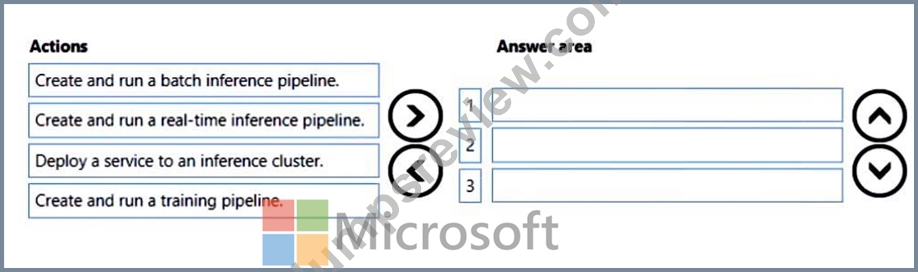
Answer:
Explanation: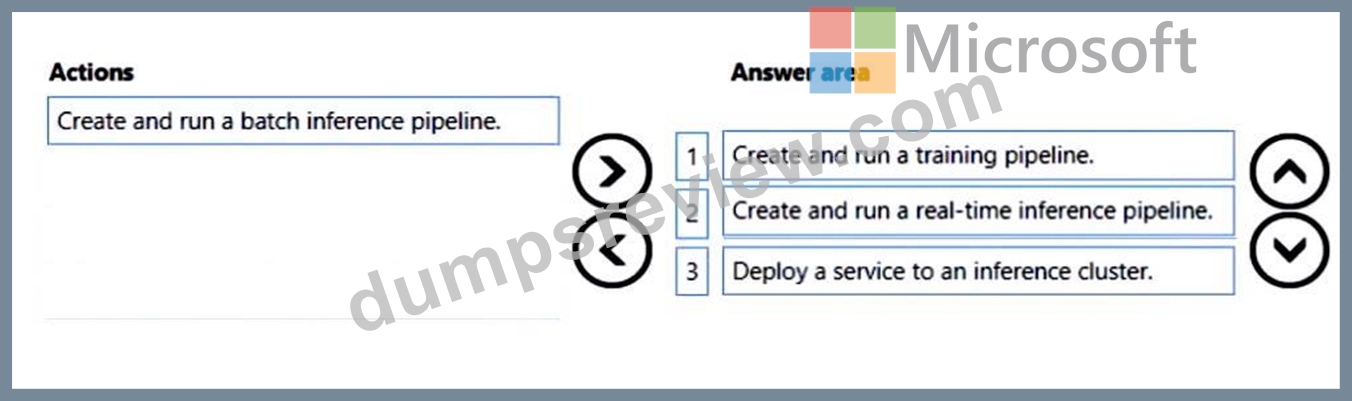
Explanation:
https://learn.microsoft.com/en-us/azure/machine-learning/tutorial-designer-automobile-price- deploy
NEW QUESTION # 158
You manage an Azure Machine Learning workspace and a GitHub repository. The GitHub repository contains a CSV file located at httpsy/raw.githubusercontent.com/account1/repo1/main/doc1/data1.csv. The CSV file includes embedded newlines.
You plan to consume the content of the CSV file in the workspace. The solution must minimize the possibility of misaligned field values when reading the file content.
You need to create a data asset that references the CSV file.
Which data asset configuration values should you use? To answer, select the appropriate options in the answer area.
NOTE: Each correct selection is worth one point.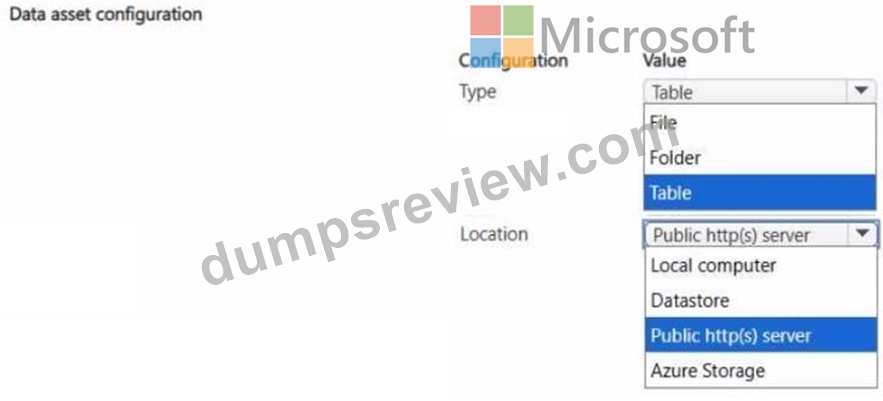
Answer:
Explanation: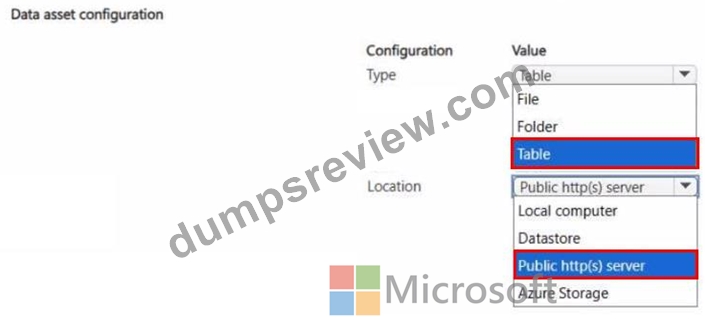
NEW QUESTION # 159
You are retrieving data from a large datastore by using Azure Machine Learning Studio.
You must create a subset of the data for testing purposes using a random sampling seed based on the system clock.
You add the Partition and Sample module to your experiment.
You need to select the properties for the module.
Which values should you select? To answer, select the appropriate options in the answer area.
NOTE: Each correct selection is worth one point.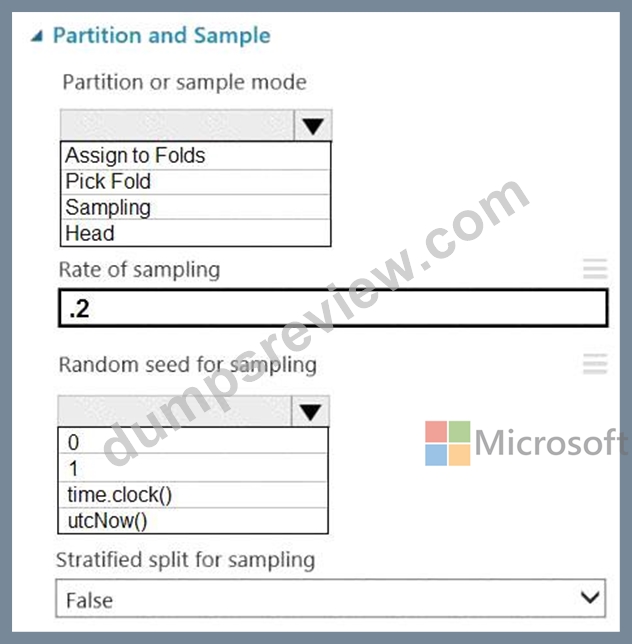
Answer:
Explanation: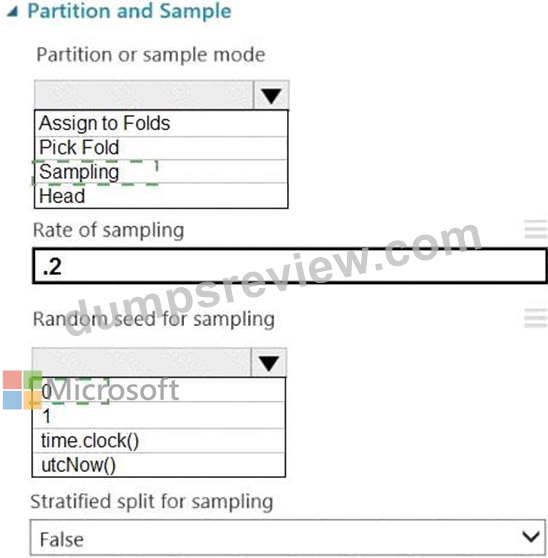
Explanation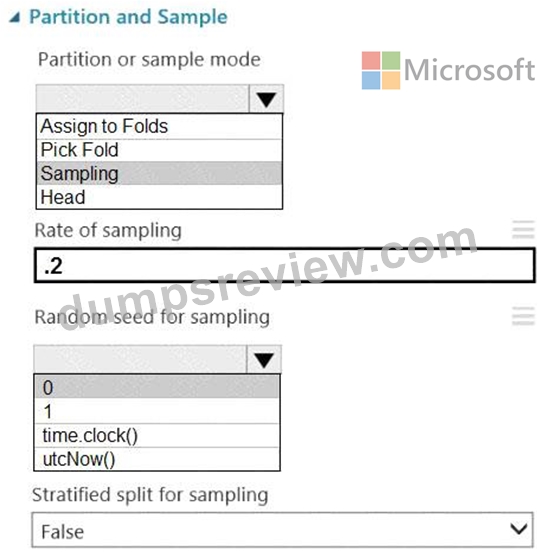
Box 1: Sampling
Create a sample of data
This option supports simple random sampling or stratified random sampling. This is useful if you want to create a smaller representative sample dataset for testing.
1. Add the Partition and Sample module to your experiment in Studio, and connect the dataset.
2. Partition or sample mode: Set this to Sampling.
3. Rate of sampling. See box 2 below.
Box 2: 0
3. Rate of sampling. Random seed for sampling: Optionally, type an integer to use as a seed value.
This option is important if you want the rows to be divided the same way every time. The default value is 0, meaning that a starting seed is generated based on the system clock. This can lead to slightly different results each time you run the experiment.
References:
https://docs.microsoft.com/en-us/azure/machine-learning/studio-module-reference/partition-and-sample
NEW QUESTION # 160
Hotspot Question
You deploy a model in Azure Container Instance.
You must use the Azure Machine Learning SDK to call the model API.
You need to invoke the deployed model using native SDK classes and methods.
How should you complete the command? To answer, select the appropriate options in the answer areas.
NOTE: Each correct selection is worth one point.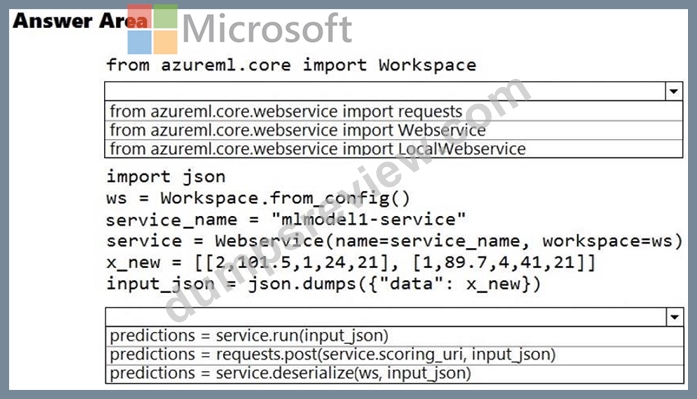
Answer:
Explanation: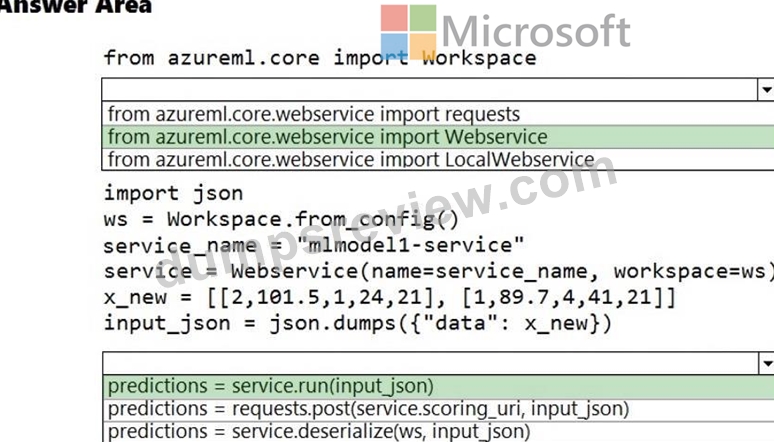
Explanation:
Box 1: from azureml.core.webservice import Webservice
The following code shows how to use the SDK to update the model, environment, and entry script for a web service to Azure Container Instances:
from azureml.core import Environment
from azureml.core.webservice import Webservice
from azureml.core.model import Model, InferenceConfig
Box 2: predictions = service.run(input_json)
Example: The following code demonstrates sending data to the service:
import json
test_sample = json.dumps({'data': [
[1, 2, 3, 4, 5, 6, 7, 8, 9, 10],
[10, 9, 8, 7, 6, 5, 4, 3, 2, 1]
]})
test_sample = bytes(test_sample, encoding='utf8')
prediction = service.run(input_data=test_sample)
print(prediction)
Reference:
https://docs.microsoft.com/bs-latn-ba/azure/machine-learning/how-to-deploy-azure-container- instance
https://docs.microsoft.com/en-us/azure/machine-learning/how-to-troubleshoot-deployment
NEW QUESTION # 161
You are working on a classification task. You have a dataset indicating whether a student would like to play soccer and associated attributes. The dataset includes the following columns:
You need to classify variables by type.
Which variable should you add to each category? To answer, select the appropriate options in the answer area.
NOTE: Each correct selection is worth one point.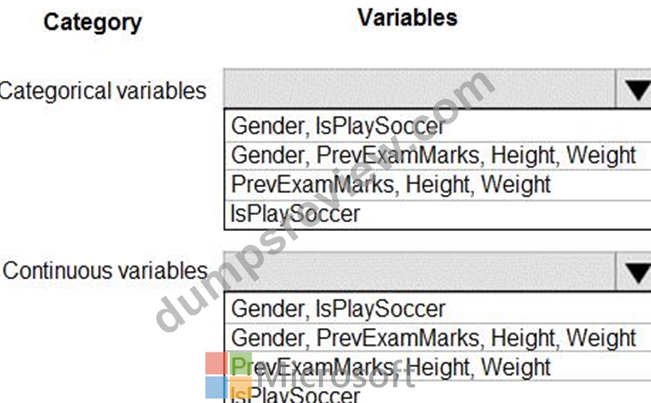
Answer:
Explanation: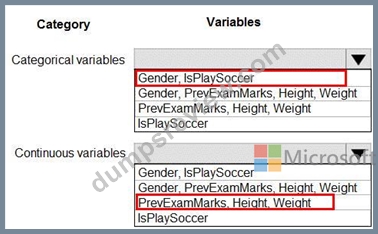
Reference:
https://www.edureka.co/blog/classification-algorithms/
NEW QUESTION # 162
You have an Azure Machine Learning workspace that contains a training cluster and an inference cluster.
You plan to create a classification model by using the Azure Machine Learning designer.
You need to ensure that client applications can submit data as HTTP requests and receive predictions as responses.
Which three actions should you perform in sequence? To answer, move the appropriate actions from the list of actions to the answer area and arrange them in the correct order.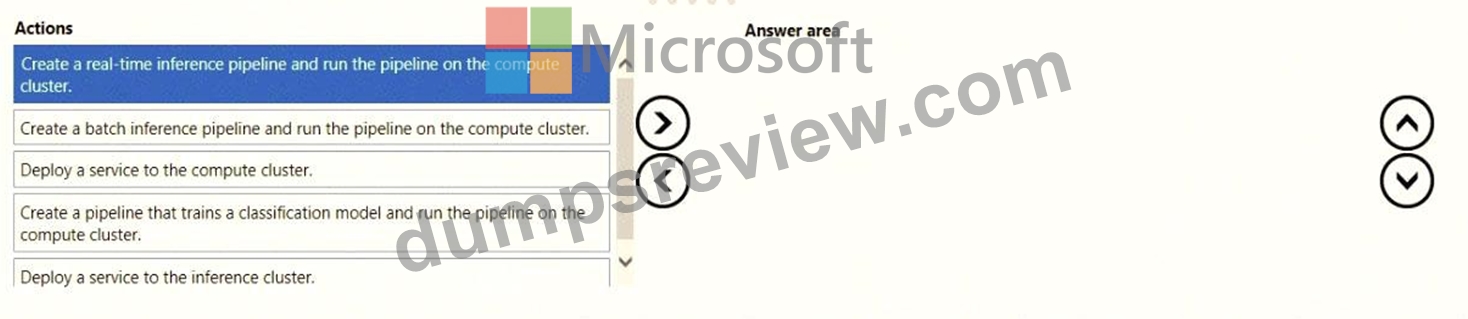
Answer:
Explanation: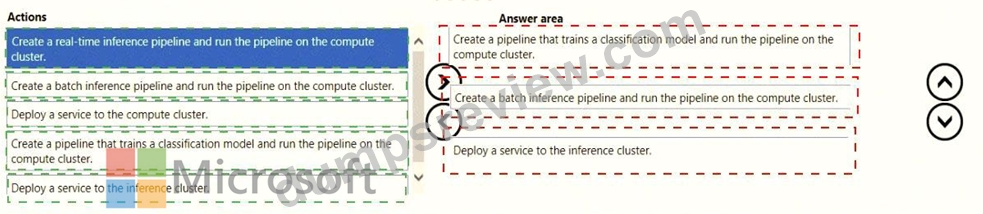
NEW QUESTION # 163
Your Azure Machine Learning workspace has a dataset named real_estate_dat a. A sample of the data in the dataset follows.
You want to use automated machine learning to find the best regression model for predicting the price column.
You need to configure an automated machine learning experiment using the Azure Machine Learning SDK.
How should you complete the code? To answer, select the appropriate options in the answer area.
NOTE: Each correct selection is worth one point.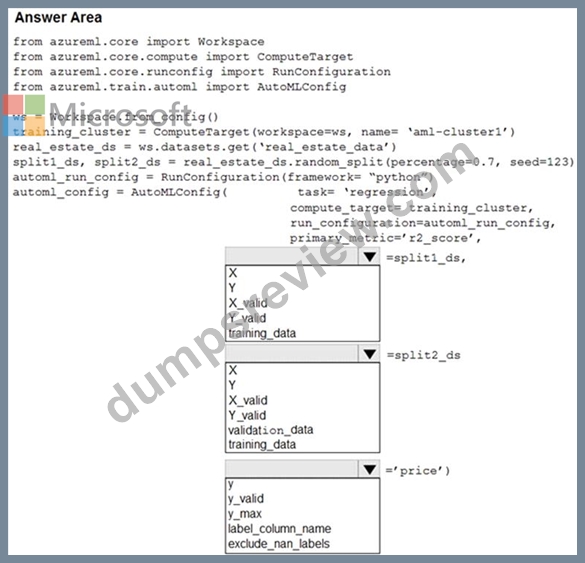
Answer:
Explanation: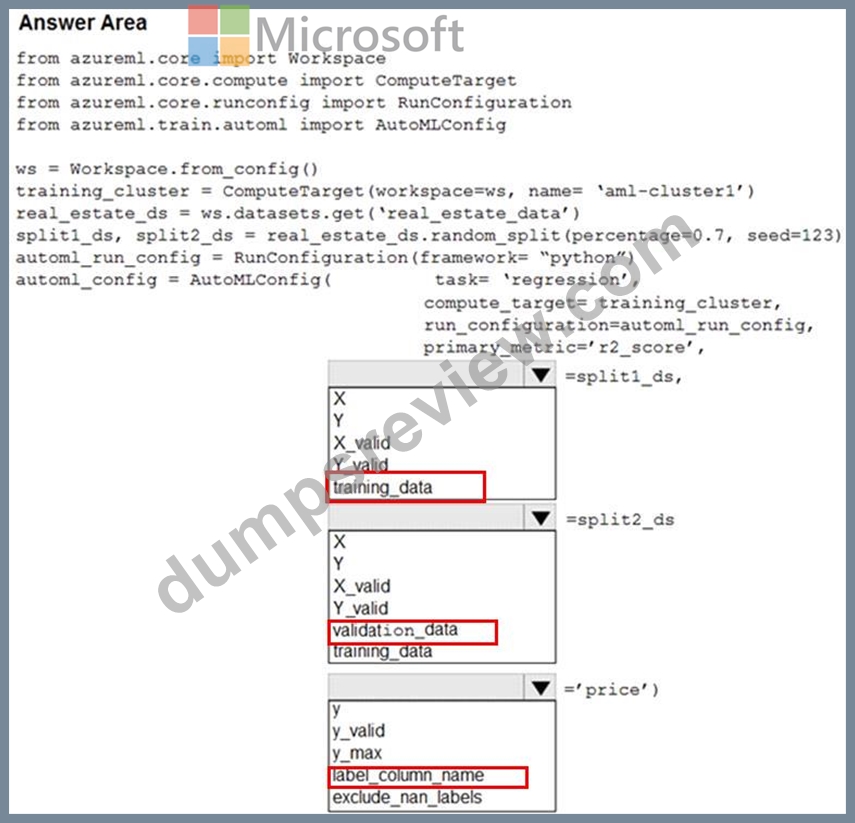
Explanation:
Box 1: training_data
The training data to be used within the experiment. It should contain both training features and a label column (optionally a sample weights column). If training_data is specified, then the label_column_name parameter must also be specified.
Box 2: validation_data
Provide validation data: In this case, you can either start with a single data file and split it into training and validation sets or you can provide a separate data file for the validation set. Either way, the validation_data parameter in your AutoMLConfig object assigns which data to use as your validation set.
Example, the following code example explicitly defines which portion of the provided data in dataset to use for training and validation.
dataset = Dataset.Tabular.from_delimited_files(data)
training_data, validation_data = dataset.random_split(percentage=0.8, seed=1) automl_config = AutoMLConfig(compute_target = aml_remote_compute, task = 'classification', primary_metric = 'AUC_weighted', training_data = training_data, validation_data = validation_data, label_column_name = 'Class' ) Box 3: label_column_name label_column_name:
The name of the label column. If the input data is from a pandas.DataFrame which doesn't have column names, column indices can be used instead, expressed as integers.
This parameter is applicable to training_data and validation_data parameters.
Incorrect Answers:
X: The training features to use when fitting pipelines during an experiment. This setting is being deprecated. Please use training_data and label_column_name instead.
Y: The training labels to use when fitting pipelines during an experiment. This is the value your model will predict. This setting is being deprecated. Please use training_data and label_column_name instead.
X_valid: Validation features to use when fitting pipelines during an experiment.
If specified, then y_valid or sample_weight_valid must also be specified.
Y_valid: Validation labels to use when fitting pipelines during an experiment.
Both X_valid and y_valid must be specified together.
exclude_nan_labels: Whether to exclude rows with NaN values in the label. The default is True.
y_max: y_max (float)
Maximum value of y for a regression experiment. The combination of y_min and y_max are used to normalize test set metrics based on the input data range. If not specified, the maximum value is inferred from the data.
Reference:
https://docs.microsoft.com/en-us/python/api/azureml-train-automl-client/azureml.train.automl.automlconfig.automlconfig?view=azure-ml-py
NEW QUESTION # 164
You use Azure Machine Learning to implement hyperparameter tuning for an Azure ML Python SDK v2- based model training.
Training runs must terminate when the primary metric is lowered by 25 percent or more compared to the best performing run.
You need to configure an early termination policy to terminate training jobs.
Which values should you use? To answer, select the appropriate options in the answer area.
NOTE: Each correct selection is worth one point.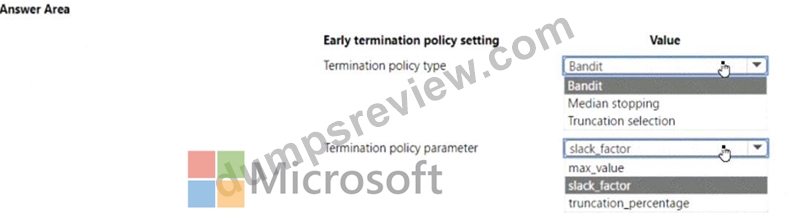
Answer:
Explanation: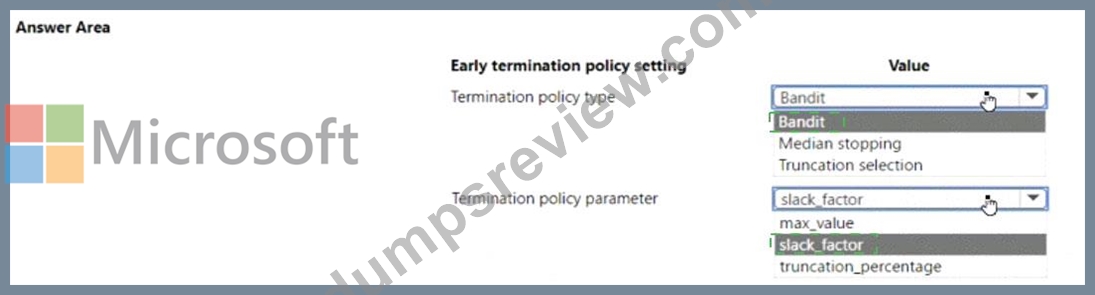
Explanation: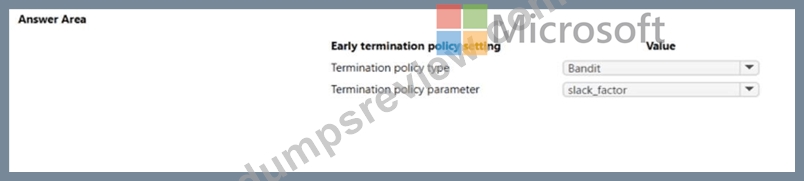
NEW QUESTION # 165
You use Azure Machine Learning to implement hyperparameter tuning for an Azure ML Python SDK v2- based model training.
Training runs must terminate when the primary metric is lowered by 25 percent or more compared to the best performing run.
You need to configure an early termination policy to terminate training jobs.
Which values should you use? To answer, select the appropriate options in the answer area.
NOTE: Each correct selection is worth one point.
Answer:
Explanation:
Explanation: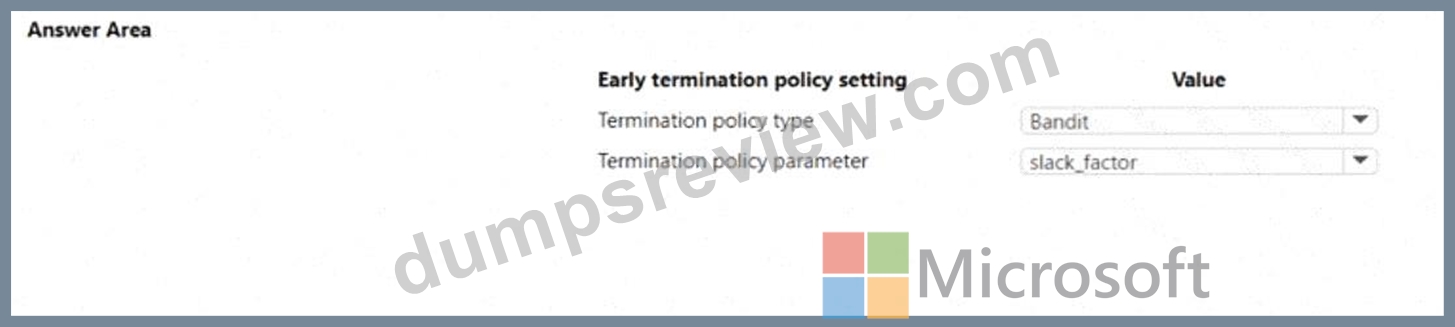
NEW QUESTION # 166
You create a training pipeline by using the Azure Machine Learning designer. You need to load data into a machine learning pipeline by using the Import Data component. Which two data sources could you use? Each correct answer presents a complete solution.
NOTE: Each correct selection is worth one point
- A. Registered dataset
- B. URL via HTTP
- C. Azure Blob storage container through a registered datastore
- D. Azure Data Lake Storage Gen2
- E. Azure SQL Database
Answer: B,C
NEW QUESTION # 167
You create an Azure Machine Learning dataset. You use the Azure Machine Learning designer to transform the dataset by using an Execute Python Script component and custom code.
You must upload the script and associated libraries as a script bundle.
You need to configure the Execute Python Script component.
Which configurations should you use? To answer, select the appropriate options in the answer area.
NOTE Each correct selection is worth one point.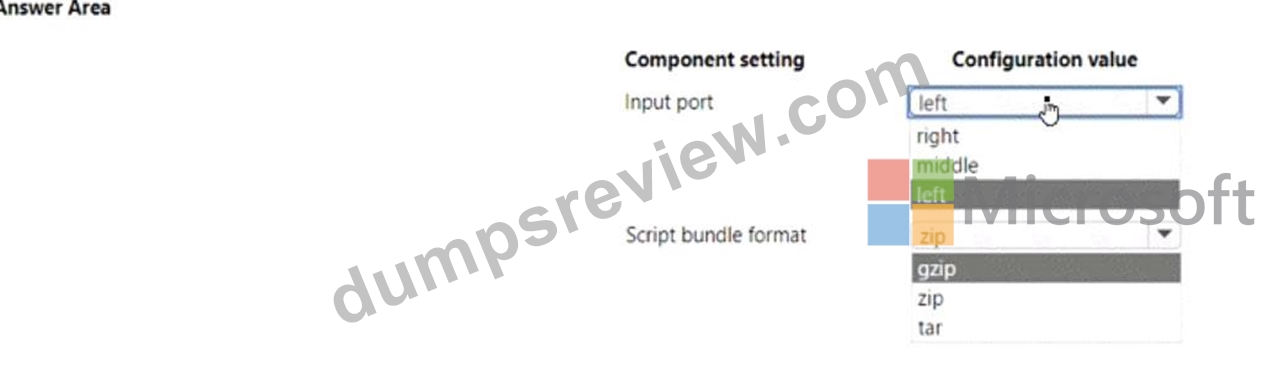
Answer:
Explanation: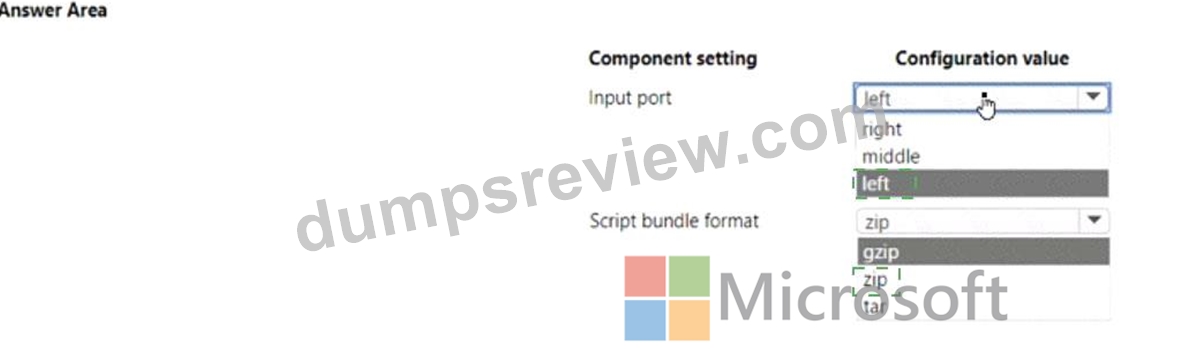
Explanation
NEW QUESTION # 168
You train classification and regression models by using automated machine learning.
You must evaluate automated machine learning experiment results. The results include how a classification model is making systematic errors in its predictions and the relationship between the target feature and the regression model's predictions. You must use charts generated by automated machine learning.
You need to choose a chart type for each model type.
Which chart types should you use? To answer, select the appropriate options in the answer area.
NOTE: Each correct selection is worth one point.
Answer:
Explanation:
see the answer below.
Explanation
See below image
NEW QUESTION # 169
You are analyzing a dataset by using Azure Machine Learning Studio. YOU need to generate a statistical summary that contains the p value and the unique value count for each feature column.
Which two modules can you users? Each correct answer presents a complete solution.
NOTE: Each correct selection is worth one point.
- A. Export Count Table
- B. Compute linear Correlation
- C. Summarize Data
- D. Convert to Indicator Values
- E. Execute Python Script
Answer: A,C
Explanation:
The Export Count Table module is provided for backward compatibility with experiments that use the Build Count Table (deprecated) and Count Featurizer (deprecated) modules.
D: Summarize Data statistics are useful when you want to understand the characteristics of the complete dataset. For example, you might need to know:
How many missing values are there in each column?
How many unique values are there in a feature column?
What is the mean and standard deviation for each column?
The module calculates the important scores for each column, and returns a row of summary statistics for each variable (data column) provided as input.
References:
https://docs.microsoft.com/en-us/azure/machine-learning/studio-module-reference/export-count-table
https://docs.microsoft.com/en-us/azure/machine-learning/studio-module-reference/summarize-data
NEW QUESTION # 170
A set of CSV files contains sales records. All the CSV files have the same data schema.
Each CSV file contains the sales record for a particular month and has the filename sales.csv. Each file in stored in a folder that indicates the month and year when the data was recorded. The folders are in an Azure blob container for which a datastore has been defined in an Azure Machine Learning workspace. The folders are organized in a parent folder named sales to create the following hierarchical structure: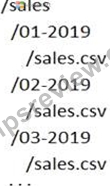
At the end of each month, a new folder with that month's sales file is added to the sales folder.
You plan to use the sales data to train a machine learning model based on the following requirements:
You must define a dataset that loads all of the sales data to date into a structure that can be easily converted to a dataframe.
You must be able to create experiments that use only data that was created before a specific previous month, ignoring any data that was added after that month.
You must register the minimum number of datasets possible.
You need to register the sales data as a dataset in Azure Machine Learning service workspace.
What should you do?
- A. Create a tabular dataset that references the datastore and explicitly specifies each 'sales/mm-yyyy/sales.csv' file. Register the dataset with the name sales_dataset each month as a new version and with a tag named month indicating the month and year it was registered. Use this dataset for all experiments, identifying the version to be used based on the month tag as necessary.
- B. Create a tabular dataset that references the datastore and specifies the path 'sales/*/sales.csv', register the dataset with the name sales_dataset and a tag named month indicating the month and year it was registered, and use this dataset for all experiments.
- C. Create a new tabular dataset that references the datastore and explicitly specifies each 'sales/mm-yyyy/ sales.csv' file every month. Register the dataset with the name sales_dataset_MM-YYYY each month with appropriate MM and YYYY values for the month and year. Use the appropriate month-specific dataset for experiments.
- D. Create a tabular dataset that references the datastore and explicitly specifies each 'sales/mm-yyyy/sales.
csv' file every month. Register the dataset with the name sales_dataset each month, replacing theexisting dataset and specifying a tag named month indicating the month and year it was registered.
Usethis dataset for all experiments.
Answer: B
Explanation:
Specify the path.
Example:
The following code gets the workspace existing workspace and the desired datastore by name. And then passes the datastore and file locations to the path parameter to create a new TabularDataset, weather_ds.
from azureml.core import Workspace, Datastore, Dataset
datastore_name = 'your datastore name'
# get existing workspace
workspace = Workspace.from_config()
# retrieve an existing datastore in the workspace by name
datastore = Datastore.get(workspace, datastore_name)
# create a TabularDataset from 3 file paths in datastore
datastore_paths = [(datastore, 'weather/2018/11.csv'),
(datastore, 'weather/2018/12.csv'),
(datastore, 'weather/2019/*.csv')]
weather_ds = Dataset.Tabular.from_delimited_files(path=datastore_paths)
NEW QUESTION # 171
You perform hyper parameter tuning with Azure Machine Learning.
You create the following Python code: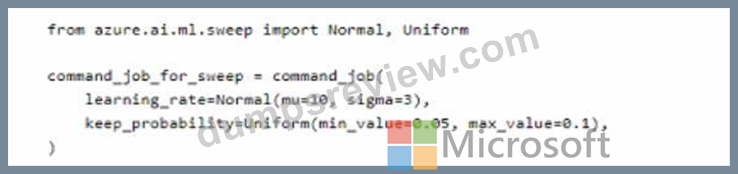
For each of the following statements, select Yes if the statement is true. Otherwise, select No.
Answer:
Explanation:
Explanation:
NEW QUESTION # 172
You are developing a linear regression model in Azure Machine Learning Studio. You run an experiment to compare different algorithms.
The following image displays the results dataset output: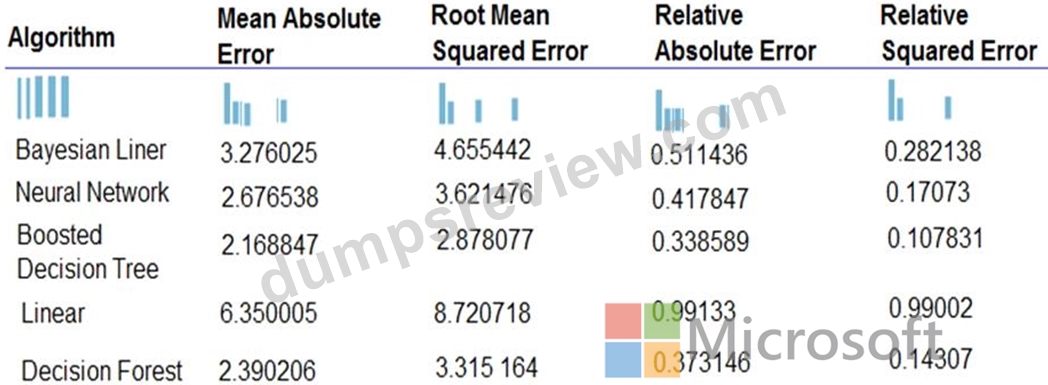
Use the drop-down menus to select the answer choice that answers each question based on the information presented in the image.
NOTE: Each correct selection is worth one point.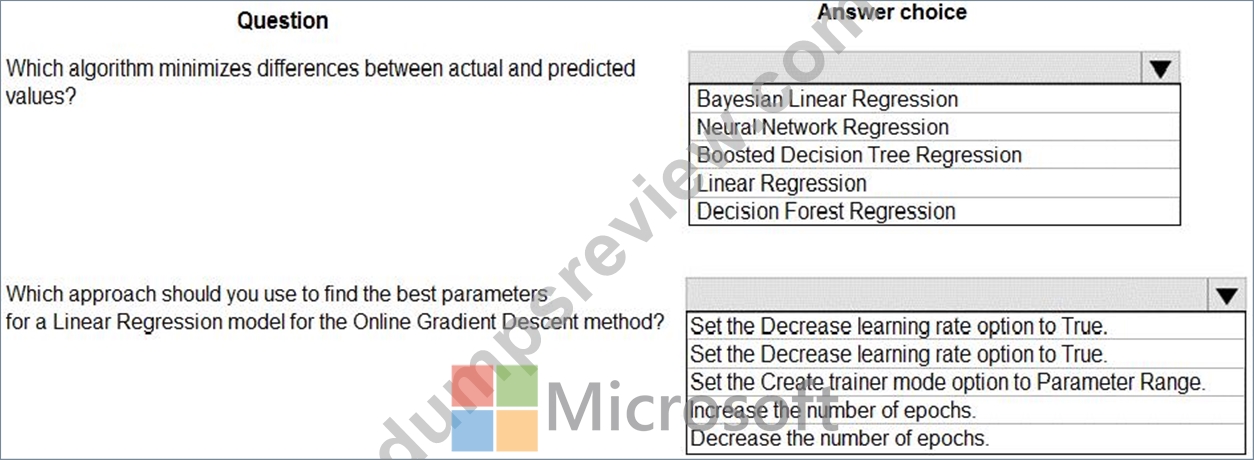
Answer:
Explanation: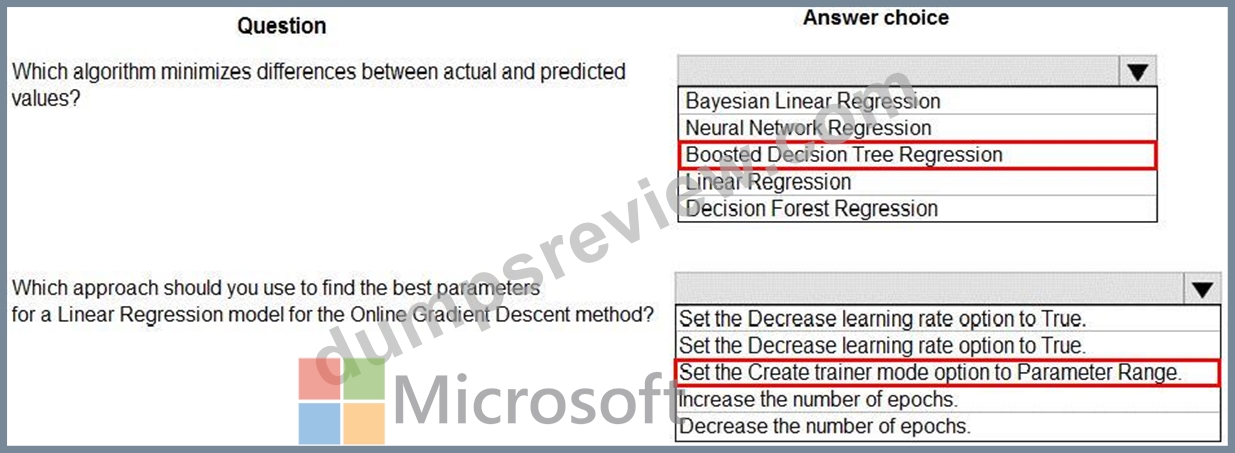
Explanation:
Box 1: Boosted Decision Tree Regression
Mean absolute error (MAE) measures how close the predictions are to the actual outcomes; thus, a lower score is better.
Box 2:
Online Gradient Descent: If you want the algorithm to find the best parameters for you, set Create trainer mode option to Parameter Range. You can then specify multiple values for the algorithm to try.
References:
https://docs.microsoft.com/en-us/azure/machine-learning/studio-module-reference/evaluate-model
https://docs.microsoft.com/en-us/azure/machine-learning/studio-module-reference/linear-regression
NEW QUESTION # 173
......
Microsoft DP-100 certification exam is designed to test the candidate's knowledge and skills in designing and implementing a data science solution on Azure. DP-100 exam is aimed at data scientists, data analysts, and other professionals who work with data and want to demonstrate their proficiency in using Azure tools and services to build scalable and efficient data solutions.
Pass Guaranteed Quiz 2026 Realistic Verified Free Microsoft: https://www.dumpsreview.com/DP-100-exam-dumps-review.html
Free Microsoft Azure DP-100 Ultimate Study Guide: https://drive.google.com/open?id=1dNtljr1gDPWI1x0VXTbLWUiCLPTKzT7g
