

Quality C_ABAPD_2309 PDF Dumps - C_ABAPD_2309 Exam Questions
Most UptoDate SAP C_ABAPD_2309 Exam Dumps PDF 2025
SAP C_ABAPD_2309 Exam Syllabus Topics:
| Topic | Details |
|---|---|
| Topic 1 |
|
| Topic 2 |
|
| Topic 3 |
|
| Topic 4 |
|
| Topic 5 |
|
NEW QUESTION # 48
Which function call returns 0?
- A. Count (val - 'ABAP ABAP abap' sub - 'AB' )
- B. Count_any_of ( val - 'ABAP ABAP abap' sub "AB" )
- C. find_any_not_of( val 'ABAP ABAP abap' sub = 'AB')
- D. find_any_of (val = "ABAP ABAP abap' sub = "AB")
Answer: C
Explanation:
Explanation
The function find_any_not_of returns the position of the first character in the string val that is not contained in the string sub. If no such character is found, the function returns 0. In this case, the string val contains only the characters A, B, and a, which are all contained in the string sub, so the function returns 0. The other functions return positive values, as follows:
Count_any_of returns the number of occurrences of any character in the string sub within the string val.
In this case, it returns 8, since there are 8 A's and B's in val.
Count returns the number of occurrences of the string sub within the string val. In this case, it returns 2, since there are 2 AB's in val.
find_any_of returns the position of the first character in the string val that is contained in the string sub.
In this case, it returns 1, since the first character A is in sub. References: String Functions - ABAP Keyword Documentation, Examples of String Functions - ABAP Keyword Documentation
NEW QUESTION # 49
Exhibit:
Which of the following statements are correct? Note: There are 2 correct answers to this question.
- A. row is a predefined name and cannot be chosen arbitrarily.
- B. FOR defines a loop that runs over the content of source_itab
- C. source_itab is only visible within the loop.
- D. row is only visible within the loop.
Answer: B,D
Explanation:
The code snippet in the image is an example of using the FOR statement to create an internal table with a constructor expression. The FOR statement introduces an iteration expression that runs over the content of source_itab and assigns each row to the variable row. The variable row is then used to populate the fields of target_itab12. Some of the correct statements about the code snippet are:
* FOR defines a loop that runs over the content of source_itab: This is true. The FOR statement iterates over the rows of source_itab and assigns each row to the variable row. The iteration expression can also specify a range or a condition for the loop12.
* row is only visible within the loop: This is true. The variable row is a local variable that is only visible within the scope of the iteration expression. It cannot be accessed outside the loop12.
You cannot do any of the following:
* source_itab is only visible within the loop: This is false. The variable source_itab is not a local variable that is defined by the FOR statement. It is an existing internal table that is used as the data source for the iteration expression. It can be accessed outside the loop12.
* row is a predefined name and cannot be chosen arbitrarily: This is false. The variable row is not a predefined name that is reserved by the FOR statement. It is a user-defined name that can be chosen arbitrarily. However, it must not conflict with any existing names in the program12.
References: 1: FOR - Iteration Expressions - ABAP Keyword Documentation - SAP Online Help 2: ABAP 7.4 Syntax - FOR Loop iteration | SAP Community
NEW QUESTION # 50
In class ZCL_CLASS_A, you use the statement DATA var TYPE ***
What may stand in place of ***? Note: There are 2 correct answers to this question.
- A. The name of a type defined privately in another class
- B. The name of a type defined privately in class ZCL_CLASS_A
- C. The name of a data element from the ABAP Dictionary
- D. The name of a domain from the ABAP Dictionary
Answer: C,D
Explanation:
In class ZCL_CLASS_A, you use the statement DATA var TYPE *** to declare a data object named var with a data type specified by ***. The data type can be any of the following1:
* A predefined ABAP type, such as i, f, c, string, xstring, and so on.
* A data element from the ABAP Dictionary, such as matnr, carrid, bukrs, and so on. A data element defines the semantic and technical attributes of a data field, such as the domain, the length, the data type, the description, and the value range2.
* A domain from the ABAP Dictionary, such as matnr_d, carrid_d, bukrs_d, and so on. A domain defines the technical attributes of a data field, such as the data type, the length, the output length, the number of decimal places, and the value range3.
* A type defined globally in a class, an interface, or a type pool, such as zcl_class_b=>type_a, zif_interface_c=>type_b, ztype_pool_d=>type_c, and so on. A global type is a type that is defined in a global repository object and can be used in any program or class4.
* A type defined locally in the current class, such as type_a, type_b, type_c, and so on. A local type is a type that is defined in the declaration part of a class and can only be used within the class5.
Therefore, the possible values for *** are B. the name of a data element from the ABAP Dictionary and D.
the name of a domain from the ABAP Dictionary. The other options are not valid because:
* A. The name of a type defined privately in class ZCL_CLASS_A is a local type and cannot be used with the DATA statement. A local type can only be used with the TYPES statement5.
* C. The name of a type defined privately in another class is a private type and cannot be accessed from outside the class. A private type can only be used within the class that defines it.
References: 1: DATA - ABAP Keyword Documentation 2: Data Elements - ABAP Dictionary - SAP Online Help 3: Domains - ABAP Dictionary - SAP Online Help 4: Global Types - ABAP Keyword Documentation 5: Local Types - ABAP Keyword Documentation : Private Types - ABAP Keyword Documentation
NEW QUESTION # 51
In a subclass subl you want to redefine a component of a superclass superl. How do you achieve this? Note: There are 2 correct answers to this question.
- A. You implement the redefined component in subl.
- B. You add the clause REDEFINITION to the component in superl.
- C. You implement the redefined component for a second time in superl.
- D. You add the clause REDEFINITION to the component in subl.
Answer: A,D
Explanation:
To redefine a component of a superclass in a subclass, you need to do the following12:
You add the clause REDEFINITION to the component declaration in the subclass. This indicates that the component is inherited from the superclass and needs to be reimplemented in the subclass. The redefinition must happen in the same visibility section as the component declaration in the superclass. For example, if the superclass has a public method m1, the subclass must also declare the redefined method m1 as public with the REDEFINITION clause.
You implement the redefined component in the subclass. This means that you provide the new logic or behavior for the component that is specific to the subclass. The redefined component in the subclass will override the original component in the superclass when the subclass object is used. For example, if the superclass has a method m1 that returns 'Hello', the subclass can redefine the method m1 to return 'Hi' instead.
You cannot do any of the following:
You implement the redefined component for a second time in the superclass. This is not possible, because the superclass already has an implementation for the component that is inherited by the subclass. The subclass is responsible for providing the new implementation for the redefined component, not the superclass.
You add the clause REDEFINITION to the component in the superclass. This is not necessary, because the superclass does not need to indicate that the component can be redefined by the subclass. The subclass is the one that needs to indicate that the component is redefined by adding the REDEFINITION clause to the component declaration in the subclass.
NEW QUESTION # 52
What are valid statements? Note: There are 2 correct answers to this question.
- A. #EC_NEEDED is not checked by the syntax checker.
- B. The pragma is not checked by the syntax checker.
- C. ##NEEDED is checked by the syntax checker.
- D. The pseudo-comment is checked by the syntax checker
Answer: B,C
Explanation:
Both statements are valid in ABAP, but they have different effects on the program.
* ##NEEDED is a pragma that can be used to hide warnings from the ABAP compiler syntax check. It tells the check tools that a variable or a parameter is needed for further processing, even if it is not used in the current statement. For example, if you declare a variable without assigning any value to it, you can use ##NEEDED to suppress the warning about unused variables12.
* The pragma is not checked by the syntax checker means that you can use any pragma to hide any warning from the ABAP compiler syntax check, regardless of its effect on the program logic or performance. For example, if you use ##SHADOW to hide a warning about an obscured function, you can also use it to hide a warning about an invalid character in a string12.
You cannot do any of the following:
* #EC_NEEDED is not checked by the syntax checker: This is not a valid statement in ABAP. There is no pseudo-comment with #EC_NEEDED in ABAP3.
* The pseudo-comment is checked by the syntax checker: This is false. Pseudo-comments are obsolete and should no longer be used in ABAP. They were replaced by pragmas since SAP NW 7.0 EhP2 (Enhancement Package)4.
References: 1: Pragmas - ABAP Keyword Documentation - SAP Online Help 2: [What are pragmas and pseudo comments in ABAP? | SAP Blogs - SAP Community] 3: ABAP Keyword Documentation - SAP Online Help 4: What are PRAGMAS and Pseudo comments in SAP ABAP
NEW QUESTION # 53
Which extensibility type does SAP recommend you use to enhance the existing UI for an SAP Fiori app?
- A. Side-by-side
- B. Developer
- C. Key user
- D. Classic
Answer: B
Explanation:
According to the SAP clean core extensibility and ABAP cloud topic, SAP recommends using developer extensibility to enhance the existing UI for an SAP Fiori app. Developer extensibility allows you to use the UI adaptation editor in SAP Web IDE to modify the UI layout, add or remove fields, and bind them to the data model. You can also use the SAPUI5 framework to create custom controls, views, and controllers. Developer extensibility is based on the in-app extensibility concept, which means that the extensions are part of the same application and are deployed together with the app. Developer extensibility requires developer skills and access to the source code of the app. Reference: SAP Learning Hub, SAP S/4HANA Cloud Extensibility - In-App Extensibility, SAP Fiori: Extensibility
NEW QUESTION # 54
Which patterns raise an exception? Note: There are 3 correct answers to this question.
- A. DATA: gv_target TYPE p DECIMALS 2. CONSTANTS: go intl TYPE i VALUE 3. gv_target -U EXACT (2 gcojntl).
- B. DATA: gv_target TYPE string. CONSTANTS: gco_string TYPE LENGTH 16 VALUE
0123456789ABCDEF*. gv_target = EXACT # gco_string+5 (5) ). - C. DATA: gv_target TYPE d. s/ CONSTANTS: gco_date TYPE d VALUE '20331233*. gv_target EXACT ( geo_date).
- D. DATA: gv_target TYPE c LENGTH 5. V CONSTANTS: ECO string TYPE string VALUE
0123456789ABCDEF". gv_target - EXACT (gco_string + 5 (6) ). - E. DATA: Ev target TYPE p DECIMALS 3. CONSTANTS: gcojntl TYPE i VALUE 2. Ev_target -U EXACT #2 / gcojntl ).
Answer: A,C,D
Explanation:
The patterns that raise an exception are those that use the constructor operator EXACT to perform a lossless assignment or calculation, but the result cannot be converted to the target data type without data loss. The following are the explanations for each pattern:
* A: This pattern raises the exception CX_SY_CONVERSION_LOST because the result of the calculation 2 * 3 is 6, which cannot be assigned to a packed number with two decimal places without losing the integer part. The operator -U is used to perform a lossless calculation with the calculation type decfloat34.
* B: This pattern does not raise an exception because the result of the substring expression gco_string+5(5) is '6789A', which can be assigned to a string without data loss. The operator EXACT # is used to perform a lossless assignment with the data type of the argument.
* C: This pattern raises the exception CX_SY_CONVERSION_LOST because the result of the substring expression gco_string+5(6) is '6789AB', which cannot be assigned to a character field with length 5 without losing the last character. The operator EXACT is used to perform a lossless assignment with the data type of the target field.
* D: This pattern does not raise an exception because the result of the calculation 2 / 2 is 1, which can be assigned to a packed number with three decimal places without data loss. The operator -U is used to
* perform a lossless calculation with the calculation type decfloat34.
* E: This pattern raises the exception CX_SY_CONVERSION_ERROR because the constant gco_date contains an invalid value '20331233' for a date data type, which cannot be converted to a valid date.
The operator EXACT is used to perform a lossless assignment with the data type of the target field.
References: EXACT - Lossless Operator - ABAP Keyword Documentation, Lossless Assignments - ABAP Keyword Documentation
NEW QUESTION # 55
Which type of legacy code does SAP recommend you eliminate when you review modifications as part of an SAP S/4HANA system conversion? Note: There are 2 correct answers to this question.
- A. Code that has less than 10% usage according to usage statistics
- B. Code that can be redesigned as a key user extension
- C. Code that now is identical to a standard SAP object
- D. Code that supports a critical business process
Answer: B,C
Explanation:
SAP recommends that you eliminate the following types of legacy code when you review modifications as part of an SAP S/4HANA system conversion:
* Code that now is identical to a standard SAP object. This type of code is redundant and unnecessary, as it does not provide any additional functionality or customization. It can also cause conflicts or errors during the system conversion, as the standard SAP object may have changed or been replaced in SAP S/4HANA. Therefore, you should delete this type of code and use the standard SAP object instead.
* Code that can be redesigned as a key user extension. This type of code is usually related to UI or business logic adaptations that can be achieved using the in-app tools provided by SAP S/4HANA. By redesigning this type of code as a key user extension, you can simplify and standardize your code base, reduce maintenance efforts, and avoid compatibility issues during the system conversion. Therefore, you should migrate this type of code to the key user extensibility framework and delete the original code.
The other types of legacy code are not recommended to be eliminated, as they may still be relevant or necessary for your business processes. However, you should still review and adjust them according to the SAP S/4HANA simplification items and best practices. These types of code are:
* Code that supports a critical business process. This type of code is essential for your business operations and cannot be easily replaced or removed. However, you should check if this type of code is compatible with SAP S/4HANA, and if not, you should adapt it accordingly. You should also consider if this type of code can be optimized or enhanced using the new features and capabilities of SAP S/4HANA.
* Code that has less than 10% usage according to usage statistics. This type of code is rarely used and may not be worth maintaining or converting. However, you should not delete this type of code without verifying its relevance and impact on your business processes. You should also consider if this type of code can be replaced or consolidated with other code that has higher usage or better performance.
References: Custom Code Management (CCM) During an SAP S/4HANA Conversion, Custom Code Migration Guide for SAP S/4HANA 2020
NEW QUESTION # 56
Which of the following is a generic internal table type?
- A. STANDARD TABLE
- B. HASHED TABLE
- C. INDEX TABLE
- D. SORTED TABLE
Answer: C
Explanation:
A generic internal table type is a table type that does not define all the attributes of an internal table in the ABAP Dictionary; it leaves some of these attributes undefined. A table type is generic in the following cases1:
You have selected Index Table or Not Specified as the access type.
You have not specified a table key or specified an incomplete table key.
You have specified a generic secondary table key.
A generic table type can be used only for typing formal parameters or field symbols. A generic table type cannot be used for defining data objects or constants2.
Therefore, the correct answer is B. INDEX TABLE, which is a generic table type that does not specify the access type or the table key. The other options are not generic table types, because:
A) SORTED TABLE is a table type that specifies the access type as sorted and the table key as a unique or non-unique primary key3.
C) STANDARD TABLE is a table type that specifies the access type as standard and the table key as a non-unique standard key that consists of all the fields of the table row in the order in which they are defined4.
D) HASHED TABLE is a table type that specifies the access type as hashed and the table key as a unique primary key5.
NEW QUESTION # 57
Exhibit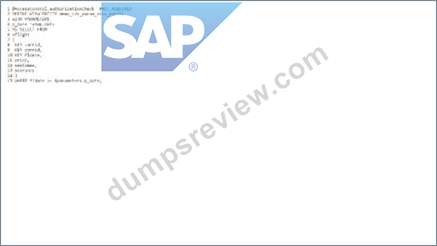
Which of the following ABAP SQL snippets are syntactically correct ways to provide a value for the parameter on line #4? Note: There are 2 correct answers to this question
- A. ...SELECT * FROM deno_cds_param_view_entity (p_date = @
(cl_abap_context_info->get_system_date ())... - B. ...SELECT * FROM deno_cds_param_view_entity (p_date - '20230101')... )
- C. ...SELECT * FROM demo_cds_param_view entity (p_date: $session.system_date)...
- D. ...SELECT * FROM demo_cds_param_view_entity (p_date: 20238181')... )
Answer: A,B
NEW QUESTION # 58
In this nested join below in which way is the join evaluated?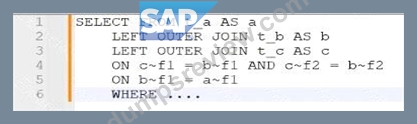
- A. From the top to the bottom in the order of the on conditions
1.
b is joined with c
2.
a is joined with b - B. From the right to the left in the order of the tables:
1.
b is joined with c.
2.
b is joined with a. - C. From the left to the right in the order of the tables:
1.
a is joined with b
2.
b is joined with c - D. From the bottom to the top in the order of the on conditions:
1.
a is joined with b
2.
b is joined with c
Answer: A
Explanation:
Explanation
The nested join is evaluated from the top to the bottom in the order of the ON conditions. This means that the join expression is formed by assigning each ON condition to the directly preceding JOIN from left to right.
The join expression can be parenthesized implicitly or explicitly to show the order of evaluation. In this case, the implicit parentheses are as follows:
SELECT * FROM (a INNER JOIN (b INNER JOIN c ON b~c = c~c) ON a~b = b~b) This means that the first join expression is b INNER JOIN c ON b~c = c~c, which joins the columns of tables b and c based on the condition that b~c equals c~c. The second join expression is a INNER JOIN (b INNER JOIN c ON b~c = c~c) ON a~b = b~b, which joins the columns of table a and the result of the first join expression based on the condition that a~b equals b~b. The final result set contains all combinations of rows from tables a, b, and c that satisfy both join conditions.
References: 1: SELECT, FROM JOIN - ABAP Keyword Documentation - SAP Online Help
NEW QUESTION # 59 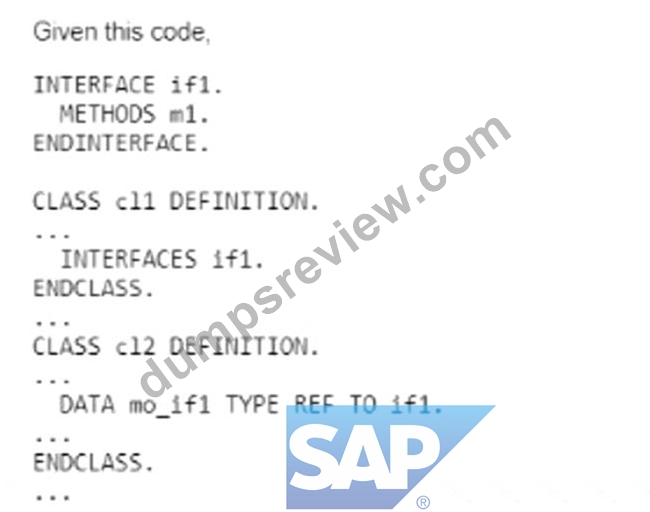
What are valid statements? Note: There are 3 correct answers to this question
- A. In class CL1, the interface method is named if-ml.
- B. Class CL1 uses the interface.
- C. Class CL1 implements the interface.
- D. Class CL2 uses the interface.
- E. In class CL2, the interface method is named ifl-ml.
Answer: B,C,E
Explanation:
The following are the explanations for each statement:
* C: This statement is valid. Class CL1 uses the interface. This is because class CL1 implements the interface ifl using the INTERFACES statement in the public section of the class definition. The INTERFACES statement makes the class compatible with the interface and inherits all the components of the interface. The class can then use the interface components, such as the method ml, by using the interface component selector ~, such as ifl~ml12
* E: This statement is valid. Class CL1 implements the interface. This is because class CL1 implements the interface ifl using the INTERFACES statement in the public section of the class definition. The INTERFACES statement makes the class compatible with the interface and inherits all the components of the interface. The class must then provide an implementation for the interface method ml in the implementation part of the class, unless the method is declared as optional or abstract12
* D: This statement is valid. In class CL2, the interface method is named ifl~ml. This is because class CL2 has a data member named m0_ifl of type REF TO ifl, which is a reference to the interface ifl. The interface ifl defines a method ml, which can be called using the reference variable m0_ifl. The interface method ml has the name ifl~ml in the class, where ifl is the name of the interface and the character ~ is the interface component selector12 The other statements are not valid, as they have syntax errors or logical errors. These statements are:
* A: This statement is not valid. In class CL1, the interface method is named ifl~ml, not if-ml. This is because class CL1 implements the interface ifl using the INTERFACES statement in the public section of the class definition. The interface ifl defines a method ml, which can be called using the class name or a reference to the class. The interface method ml has the name ifl~ml in the class, where ifl is the name of the interface and the character ~ is the interface component selector. Using the character - instead of the character ~ will cause a syntax error12
* B: This statement is not valid. Class CL2 does not use the interface, but only has a reference to the interface. This is because class CL2 has a data member named m0_ifl of type REF TO ifl, which is a reference to the interface ifl. The interface ifl defines a method ml, which can be called using the reference variable m0_ifl. However, class CL2 does not implement the interface ifl, nor does it inherit the interface components. Therefore, class CL2 does not use the interface, but only references the interface12 References: INTERFACES - ABAP Keyword Documentation, CLASS - ABAP Keyword Documentation
NEW QUESTION # 60
In class ZCL_CLASS_A, you use the statement DATA var TYPE ***
What may stand in place of ***? Note: There are 2 correct answers to this question.
- A. The name of a type defined privately in another class
- B. The name of a type defined privately in class ZCL_CLASS_A
- C. The name of a data element from the ABAP Dictionary
- D. The name of a domain from the ABAP Dictionary
Answer: C,D
Explanation:
Explanation
In class ZCL_CLASS_A, you use the statement DATA var TYPE *** to declare a data object named var with a data type specified by ***. The data type can be any of the following1:
A predefined ABAP type, such as i, f, c, string, xstring, and so on.
A data element from the ABAP Dictionary, such as matnr, carrid, bukrs, and so on. A data element defines the semantic and technical attributes of a data field, such as the domain, the length, the data type, the description, and the value range2.
A domain from the ABAP Dictionary, such as matnr_d, carrid_d, bukrs_d, and so on. A domain defines the technical attributes of a data field, such as the data type, the length, the output length, the number of decimal places, and the value range3.
A type defined globally in a class, an interface, or a type pool, such as zcl_class_b=>type_a, zif_interface_c=>type_b, ztype_pool_d=>type_c, and so on. A global type is a type that is defined in a global repository object and can be used in any program or class4.
A type defined locally in the current class, such as type_a, type_b, type_c, and so on. A local type is a type that is defined in the declaration part of a class and can only be used within the class5.
Therefore, the possible values for *** are B. the name of a data element from the ABAP Dictionary and D. the name of a domain from the ABAP Dictionary. The other options are not valid because:
A). The name of a type defined privately in class ZCL_CLASS_A is a local type and cannot be used with the DATA statement. A local type can only be used with the TYPES statement5.
C). The name of a type defined privately in another class is a private type and cannot be accessed from outside the class. A private type can only be used within the class that defines it.
References: 1: DATA - ABAP Keyword Documentation 2: Data Elements - ABAP Dictionary - SAP Online Help 3: Domains - ABAP Dictionary - SAP Online Help 4: Global Types - ABAP Keyword Documentation 5:
Local Types - ABAP Keyword Documentation : Private Types - ABAP Keyword Documentation
NEW QUESTION # 61
Which extensibility type does SAP recommend you use to enhance the existing UI for an SAP Fiori app?
- A. Side-by-side
- B. Developer
- C. Key user
- D. Classic
Answer: B
Explanation:
According to the SAP clean core extensibility and ABAP cloud topic, SAP recommends using developer extensibility to enhance the existing UI for an SAP Fiori app. Developer extensibility allows you to use the UI adaptation editor in SAP Web IDE to modify the UI layout, add or remove fields, and bind them to the data model. You can also use the SAPUI5 framework to create custom controls, views, and controllers. Developer extensibility is based on the in-app extensibility concept, which means that the extensions are part of the same application and are deployed together with the app. Developer extensibility requires developer skills and access to the source code of the app. References: SAP Learning Hub, SAP S/4HANA Cloud Extensibility - In-App Extensibility, SAP Fiori: Extensibility
NEW QUESTION # 62
In a subclass subl you want to redefine a component of a superclass superl. How do you achieve this? Note:
There are 2 correct answers to this question.
- A. You implement the redefined component in subl.
- B. You add the clause REDEFINITION to the component in superl.
- C. You implement the redefined component for a second time in superl.
- D. You add the clause REDEFINITION to the component in subl.
Answer: A,D
Explanation:
Explanation
To redefine a component of a superclass in a subclass, you need to do the following12:
You add the clause REDEFINITION to the component declaration in the subclass. This indicates that the component is inherited from the superclass and needs to be reimplemented in the subclass. The redefinition must happen in the same visibility section as the component declaration in the superclass.
For example, if the superclass has a public method m1, the subclass must also declare the redefined method m1 as public with the REDEFINITION clause.
You implement the redefined component in the subclass. This means that you provide the new logic or behavior for the component that is specific to the subclass. The redefined component in the subclass will override the original component in the superclass when the subclass object is used. For example, if the superclass has a method m1 that returns 'Hello', the subclass can redefine the method m1 to return 'Hi' instead.
You cannot do any of the following:
You implement the redefined component for a second time in the superclass. This is not possible, because the superclass already has an implementation for the component that is inherited by the subclass. The subclass is responsible for providing the new implementation for the redefined component, not the superclass.
You add the clause REDEFINITION to the component in the superclass. This is not necessary, because the superclass does not need to indicate that the component can be redefined by the subclass. The subclass is the one that needs to indicate that the component is redefined by adding the REDEFINITION clause to the component declaration in the subclass.
References:1:METHODS - REDEFINITION - ABAP Keyword Documentation - SAP Online Help2:Redefining Methods - ABAP Keyword Documentation - SAP Online Help
NEW QUESTION # 63
In RESTful Application Programming, which EML statement retrieves an object?
- A. Read entity
- B. Select entity
- C. Find entity
- D. Get entity
Answer: D
Explanation:
Explanation
In RESTful Application Programming, the EML statement that retrieves an object is GET entity. The GET entity statement is used to read data of an entity instance from the database or the transaction buffer. The GET entity statement can specify the entity name, the entity key, and the entity elements to be retrieved. The GET entity statement can also use the IN LOCAL MODE addition to bypass the access control, authorization control, and feature control checks. The GET entity statement returns a single entity instance or raises an exception if no instance is found or multiple instances match the key.
The other EML statements are not used to retrieve an object, but have different purposes and effects. These statements are:
FIND entity: This statement is used to search for entity instances that match a given condition. The FIND entity statement can specify the entity name, the entity elements to be returned, and the condition to be applied. The FIND entity statement can also use the IN LOCAL MODE addition to bypass the access control, authorization control, and feature control checks. The FIND entity statement returns a table of entity instances or an empty table if no instances match the condition.
SELECT entity: This statement is used to query data of entity instances from the database or the transaction buffer. The SELECT entity statement can specify the entity name, the entity elements to be returned, and the filter, order, and aggregation options to be applied. The SELECT entity statement can also use the IN LOCAL MODE addition to bypass the access control, authorization control, and feature control checks. The SELECT entity statement returns a table of entity instances or an empty table if no instances match the query.
READ entity: This statement is not a valid EML statement, but an ABAP statement. The READ statement is used to access a single row of an internal table using the table index or the table key. The READ statement can also use the TRANSPORTING addition to specify which fields should be returned, and the INTO addition to specify the target variable. The READ statement returns a single row of the internal table or raises an exception if no row is found or multiple rows match the key.
References: GET ENTITY - ABAP Keyword Documentation, FIND ENTITY, ENTITIES - ABAP Keyword Documentation, SELECT ENTITY, ENTITIES - ABAP Keyword Documentation, READ - ABAP Keyword Documentation
NEW QUESTION # 64
......
100% Free SAP Certified Associate C_ABAPD_2309 Dumps PDF Demo Cert Guide Cover: https://www.dumpsreview.com/C_ABAPD_2309-exam-dumps-review.html
PDF Exam Material 2025 Realistic C_ABAPD_2309 Dumps Questions: https://drive.google.com/open?id=1FKLI1NUXwaW40eDc3y4t99GtwLhMC7yM
