

100% Real & Accurate 212-82 Questions and Answers with Free and Fast Updates
Get Unlimited Access to 212-82 Certification Exam Cert Guide
ECCouncil 212-82 Certified Cybersecurity Technician Exam is an essential certification for anyone looking to enter the cybersecurity field or advance their cybersecurity career. It validates that an individual has the knowledge and skills required to protect an organization's data and systems against cyber threats. By obtaining this certification, individuals can differentiate themselves in the competitive cybersecurity job market and demonstrate their commitment to cybersecurity best practices.
NEW QUESTION # 37
A web application, www.moviescope.com. hosted on your tarqet web server is vulnerable to SQL injection attacks. Exploit the web application and extract the user credentials from the moviescope database. Identify the UID (user ID) of a user, John, in the database. Note: Vou have an account on the web application, and your credentials are samAest.
(Practical Question)
- A. 0
- B. 1
- C. 2
- D. 3
Answer: A
Explanation:
4 is the UID (user ID) of a user, John, in the database in the above scenario. A web application is a software application that runs on a web server and can be accessed by users through a web browser. A web application can be vulnerable to SQL injection attacks, which are a type of web application attack that exploit a vulnerability in a web application that allows an attacker to inject malicious SQL statements into an input field, such as a username or password field, and execute them on the database server. SQL injection can be used to bypass authentication, access or modify sensitive data, execute commands, etc. To exploit the web application and extract the user credentials from the moviescope database, one has to follow these steps:
* Open a web browser and type www.moviescope.com
* Press Enter key to access the web application.
* Enter sam as username and test as password.
* Click on Login button.
* Observe that a welcome message with username sam is displayed.
* Click on Logout button.
* Enter sam' or '1'='1 as username and test as password.
* Click on Login button.
* Observe that a welcome message with username admin is displayed, indicating that SQL injection was successful.
* Click on Logout button.
* Enter sam'; SELECT * FROM users; - as username and test as password.
* Click on Login button.
* Observe that an error message with user credentials from users table is displayed.
The user credentials from users table are: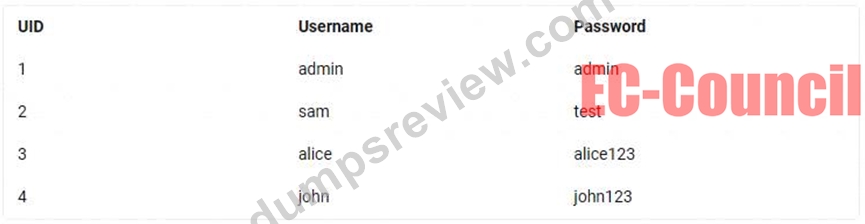
The UID that is mapped to user john is 4
NEW QUESTION # 38
Cassius, a security professional, works for the risk management team in an organization. The team is responsible for performing various activities involved in the risk management process. In this process, Cassius was instructed to select and implement appropriate controls on the identified risks in order to address the risks based on their severity level.
Which of the following risk management phases was Cassius instructed to perform in the above scenario?
- A. Risk prioritization
- B. Risk identification
- C. Risk treatment
- D. Risk analysis
Answer: C
Explanation:
Risk treatment is the risk management phase that Cassius was instructed to perform in the above scenario.
Risk management is a process that involves identifying, analyzing, evaluating, treating, monitoring, and reviewing risks that can affect an organization's objectives, assets, or operations. Risk management phases can be summarized as follows: risk identification, risk analysis, risk prioritization, risk treatment, and risk monitoring . Risk identification is the risk management phase that involves identifying and documenting potential sources, causes, events, and impacts of risks. Risk analysis is the risk management phase that involves assessing and quantifying the likelihood and consequences of risks. Risk prioritization is the risk management phase that involves ranking risks based on their severity level and determining which risks need immediate attention or action. Risk treatment is the risk management phase that involves selecting and implementing appropriate controls or strategies to address risks based on their severity level . Risk treatment can include avoiding, transferring, reducing, or accepting risks. Risk monitoring is the risk management phase that involves tracking and reviewing the performance and effectiveness of risk controls or strategies over time.
NEW QUESTION # 39
Bob was recently hired by a medical company after it experienced a major cyber security breach. Many patients are complaining that their personal medical records are fully exposed on the Internet and someone can find them with a simple Google search. Bob's boss is very worried because of regulations that protect those dat a. Which of the following regulations is mostly violated?
- A. PCIDSS
- B. Pll
- C. HIPPA/PHl
- D. ISO 2002
Answer: C
Explanation:
HIPPA/PHI is the regulation that is mostly violated in the above scenario. HIPPA (Health Insurance Portability and Accountability Act) is a US federal law that sets standards for protecting the privacy and security of health information. PHI (Protected Health Information) is any information that relates to the health or health care of an individual and that can identify the individual, such as name, address, medical records, etc. HIPPA/PHI requires covered entities, such as health care providers, health plans, or health care clearinghouses, and their business associates, to safeguard PHI from unauthorized access, use, or disclosure . In the scenario, the medical company experienced a major cyber security breach that exposed the personal medical records of many patients on the internet, which violates HIPPA/PHI regulations. PII (Personally Identifiable Information) is any information that can be used to identify a specific individual, such as name, address, social security number, etc. PII is not specific to health information and can be regulated by various laws, such as GDPR (General Data Protection Regulation), CCPA (California Consumer Privacy Act), etc. PCI DSS (Payment Card Industry Data Security Standard) is a set of standards that applies to entities that store, process, or transmit payment card information, such as merchants, service providers, or payment processors. PCI DSS requires them to protect cardholder data from unauthorized access, use, or disclosure. ISO 2002 (International Organization for Standardization 2002) is not a regulation, but a standard for information security management systems that provides guidelines and best practices for organizations to manage their information security risks.
NEW QUESTION # 40
PolarFin. a global finance institution, is in the process of migrating to a new transactional system.
Given the sensitivity of financial data and international regulations it adheres to. PolarFin needs an encryption algorithm that provides strong security and Is also widely accepted Internationally.
The algorithm should also support both encryption and decryption functions. Which cryptographic algorithm should PolarFin consider as its primary choice for this transition?
- A. DES (Data Encryption Standard)
- B. HMAC (Hash-Based Message Authentication Code)
- C. RSA (Rivest Shamir Adleman)
- D. Blowfish
Answer: C
NEW QUESTION # 41
Kevin, a professional hacker, wants to penetrate CyberTech Inc.'s network. He employed a technique, using which he encoded packets with Unicode characters. The company's IDS cannot recognize the packet, but the target web server can decode them.
What is the technique used by Kevin to evade the IDS system?
- A. Obfuscating
- B. Urgency flag
- C. Desynchronization
- D. Session splicing
Answer: A
Explanation:
Obfuscating is the technique used by Kevin to evade the IDS system in the above scenario. Obfuscating is a technique that involves encoding or modifying packets or data with various methods or characters to make them unreadable or unrecognizable by an IDS (Intrusion Detection System). Obfuscating can be used to bypass or evade an IDS system that relies on signatures or patterns to detect malicious activities. Obfuscating can include encoding packets with Unicode characters, which are characters that can represent various languages and symbols. The IDS system cannot recognize the packet, but the target web server can decode them and execute them normally. Desynchronization is a technique that involves creating discrepancies or inconsistencies between the state of a connection as seen by an IDS system and the state of a connection as seen by the end hosts. Desynchronization can be used to bypass or evade an IDS system that relies on stateful inspection to track and analyze connections. Desynchronization can include sending packets with invalid sequence numbers, which are numbers that indicate the order of packets in a connection. Session splicing is a technique that involves splitting or dividing packets or data into smaller fragments or segmentsto make them harder to detect by an IDS system. Session splicing can be used to bypass or evade an IDS system that relies on packet size or content to detect malicious activities. Session splicing can include sending packets with small MTU (Maximum Transmission Unit) values, which are values that indicate the maximum size of packets that can be transmitted over a network. An urgency flag is a flag in the TCP (Transmission Control Protocol) header that indicates that the data in the packet is urgent and should be processed immediately by the receiver.
An urgency flag is not a technique to evade an IDS system, but it can be used to trigger an IDS system to generate an alert or a response.
NEW QUESTION # 42
An IoT device that has been placed in a hospital for safety measures, it has sent an alert command to the server. The network traffic has been captured and stored in the Documents folder of the Attacker Machine-1. Analyze the loTdeviceTraffic.pcapng file and select the appropriate command that was sent by the IoT device over the network.
- A. Low_Tempe
- B. High_Tempe
- C. Tempe_Low
- D. Temp_High
Answer: D
NEW QUESTION # 43
Ruben, a crime investigator, wants to retrieve all the deleted files and folders in the suspected media without affecting the original files. For this purpose, he uses a method that involves the creation of a cloned copy of the entire media and prevents the contamination of the original media.
Identify the method utilized by Ruben in the above scenario.
- A. Drive decryption
- B. Logical acquisition
- C. Sparse acquisition
- D. Bit-stream imaging
Answer: D
Explanation:
Bit-stream imaging is the method utilized by Ruben in the above scenario. Bit-stream imaging is a method that involves creating a cloned copy of the entire media and prevents the contamination of the original media.
Bit-stream imaging copies all the data on the media, including deleted files and folders, hidden partitions, slack space, etc., at a bit level. Bit-stream imaging preserves the integrity and authenticity of the digital evidence and allows further analysis without affecting the original media. Sparse acquisition is a method that involves creating a partial copy of the media by skipping empty sectors or blocks. Drive decryption is a method that involves decrypting an encrypted drive or partition using a password or a key. Logical acquisition is a method that involves creating a copy of the logical files and folders on the media using file system commands.
NEW QUESTION # 44
A major metropolitan municipal corporation had deployed an extensive loT network for managing various facilities in the city. A recent cyber attack has paralyzed the city's vital services, bringing them to a complete halt. The Security Operations Center (SOC) has captured the network traffic during the attack and stored It as loT_capture.pcapng in the Documents folder of the Attacker Machine-1. Analyze the capture file and identify the command that was sent to the loT devices over the network. (Practical Question)
- A. Nature_Blaze_Warning555
- B. Forest_Fire_Alert444
- C. Woodland_Blaze_ Warninggil
- D. Woodland_Blaze_Warning999
Answer: B
Explanation:
To analyze the IoT network traffic capture and identify the command sent to IoT devices, follow these steps:
* Open the Capture File:
* Use a network analysis tool like Wireshark to open theIoT_capture.pcapngfile.
* Filter and Analyze:
* Apply appropriate filters to isolate relevant traffic. Look for command patterns typically sent to IoT devices.
* Identify the Command:
* Upon analyzing the captured traffic, the commandForest_Fire_Alert444is identified as the one sent over the network to IoT devices during the attack.
References:
* Wireshark User Guide: Wireshark Documentation
* Analysis of IoT network traffic:IoT Security
NEW QUESTION # 45
In an organization, all the servers and database systems are guarded in a sealed room with a single-entry point.
The entrance is protected with a physical lock system that requires typing a sequence of numbers and letters by using a rotating dial that intermingles with several other rotating discs.
Which of the following types of physical locks is used by the organization in the above scenario?
- A. Digital locks
- B. Combination locks
- C. Mechanical locks
- D. Electromagnetic locks
Answer: B
Explanation:
It identifies the type of physical lock used by the organization in the above scenario. A physical lock is a device that prevents unauthorized access to a door, gate, cabinet, or other enclosure by using a mechanism that requires a key, code, or biometric factor to open or close it. There are different types of physical locks, such as:
* Combination lock: This type of lock requires typing a sequence of numbers and letters by using a rotating dial that intermingles with several other rotating discs. This type of lock is suitable for securing safes, lockers, or cabinets that store valuable items or documents.
* Digital lock: This type of lock requires entering a numeric or alphanumeric code by using a keypad or touchscreen. This type of lock is suitable for securing doors or gates that require frequent access or multiple users.
* Mechanical lock: This type of lock requires inserting and turning a metal key that matches the shape and size of the lock. This type of lock is suitable for securing doors or gates that require simple and reliable access or single users.
* Electromagnetic lock: This type of lock requires applying an electric current to a magnet that attracts a metal plate attached to the door or gate. This type of lock is suitable for securing doors or gates that require remote control or integration with other security systems.
In the above scenario, the organization used a combination lock that requires typing a sequence of numbers and letters by using a rotating dial that intermingles with several other rotating discs. Option A is incorrect, as it does not identify the type of physical lock used by the organization in the above scenario. A digital lock requires entering a numeric or alphanumeric code by using a keypad or touchscreen. In the above scenario, the organization did not use a digital lock, but a combination lock. Option C is incorrect, as it does not identify the type of physical lock used by the organization in the above scenario. A mechanical lock requires inserting and turning a metal key that matches the shape and size of the lock. In the above scenario, the organization did not use a mechanical lock, but a combination lock. Option D is incorrect, as it does not identify the type of physical lock used by the organization in the above scenario. An electromagnetic lock requires applying an electric current to a magnet that attracts a metal plate attached to the door or gate. In the above scenario, the organization did not use an electromagnetic lock, but a combination lock. References: , Section 7.2
NEW QUESTION # 46
Rickson, a security professional at an organization, was instructed to establish short-range communication between devices within a range of 10 cm. For this purpose, he used a mobile connection method that employs electromagnetic induction to enable communication between devices. The mobile connection method selected by Rickson can also read RFID tags and establish Bluetooth connections with nearby devices to exchange information such as images and contact lists.
Which of the following mobile connection methods has Rickson used in above scenario?
- A. ANT
- B. Cellular communication
- C. Satcom
- D. NFC
Answer: D
Explanation:
NFC (Near Field Communication) is the mobile connection method that Rickson has used in the above scenario. NFC is a short-range wireless communication technology that enables devices to exchange data within a range of 10 cm. NFC employs electromagnetic induction to create a radio frequency field between two devices. NFC can also read RFID tags and establish Bluetooth connections with nearby devices to exchange information such as images and contact lists . Satcom (Satellite Communication) is a mobile connection method that uses satellites orbiting the earth to provide communication services over long distances. Cellular communication is a mobile connection method that uses cellular networks to provide voice and data services over wireless devices. ANT is a low-power wireless communication technology that enables devices to create personal area networks and exchange data over short distances.
NEW QUESTION # 47
A software company has implemented a wireless technology to track the employees' attendance by recording their in and out timings. Each employee in the company will have an entry card that is embedded with a tag. Whenever an employee enters the office premises, he/she is required to swipe the card at the entrance. The wireless technology uses radio-frequency electromagnetic waves to transfer data for automatic identification and for tracking tags attached to objects.
Which of the following technologies has the software company implemented in the above scenario?
- A. Bluetooth
- B. RFID
- C. WiMAX
- D. Wi-Fi
Answer: B
NEW QUESTION # 48
Henry Is a cyber security specialist hired by BlackEye - Cyber security solutions. He was tasked with discovering the operating system (OS) of a host. He used the Unkornscan tool to discover the OS of the target system. As a result, he obtained a TTL value, which Indicates that the target system is running a Windows OS. Identify the TTL value Henry obtained, which indicates that the target OS is Windows.
- A. 0
- B. 1
- C. 2
- D. 3
Answer: B
Explanation:
128 is the TTL value that Henry obtained, which indicates that the target OS is Windows. TTL (Time to Live) is a field in the IP (Internet Protocol) header that specifies how long a packet can remain in a network before it is discarded or dropped. TTL is usually expressed in seconds or hops (the number of routers or gateways that a packet passes through). TTL is used to prevent packets from looping endlessly in a network or consuming network resources . Different operating systems have different default TTL values for their packets. By observing the TTL value of a packet from a target system or network, one can infer the operating system of the target . Some common TTL values and their corresponding operating systems are:
64: Linux, Unix, Android
128: Windows
255: Cisco IOS
60: Mac OS
In the scenario, Henry used Nmap tool to discover the OS of the target system. Nmap (Network Mapper) is a tool that can perform various network scanning and enumeration tasks, such as port scanning, OS detection, service identification, etc . Nmap can use various techniques to detect the OS of a target system, such as TCP/IP fingerprinting, which involves analyzing various TCP/IP characteristics of packets from the target system, such as TTL value. In the scenario, Henry obtained a TTL value of 128 , which indicates that the target OS is Windows.
NEW QUESTION # 49
A company decided to implement the cloud infrastructure within its corporate firewall 10 secure sensitive data from external access. The company invested heavily in creating a cloud architecture within its premises to manage full control over its corporate data.
Which of the following types of cloud deployment models did the company implement in this scenario?
- A. Multi cloud
- B. Public cloud
- C. Community cloud
- D. Private cloud
Answer: D
Explanation:
Private cloud is the type of cloud deployment model that the company implemented in this scenario. Cloud computing is a model that provides on-demand access to shared and scalable computing resources, such as servers, storage, networks, applications, etc., over the internet or a network. Cloud computing can have different types based on its service or deployment model. A cloud deployment model defines how and where the cloud infrastructure and services are hosted and accessed.A cloud deployment model can have different types, such as public cloud, private cloud, hybrid cloud, community cloud, etc. A private cloud is a type of cloud deployment model that provides exclusive access to cloud infrastructure and services to a single organization or entity.A private cloud can be hosted within or outside the organization's premises and managed by the organization or a third-party provider.A private cloud can be used to secure sensitive data from external access and maintain full control over the corporate data.In the scenario, the company decided to implement the cloud infrastructure within its corporate firewall to secure sensitive data from external access. The company invested heavily in creating a cloud architecture within its premises to manage full control over its corporate data. This means that the company implemented a private cloud for this purpose. A multi-cloud is not a type of cloud deployment model, but a term that describes a strategy that uses multiple public or private clouds from different providers for different purposes or functions.A public cloud is a type of cloud deployment model that provides open access to cloud infrastructure and services to multiple organizations or entities over the internet.A public cloud can be hosted and managed by a third- party provider that owns and operates the cloud infrastructure and services.A community cloud is a type of cloud deployment model that provides shared access to cloud infrastructure and services to multiple organizations or entities that have common interests or goals.
NEW QUESTION # 50
Which of the following are examples of physical security controls? (Select all that apply)
- A. Biometric access control
- B. Encryption algorithms
- C. Firewalls
- D. Security guards
Answer: A,D
NEW QUESTION # 51
Wilson, a security specialist in an organization, was instructed to enhance its cloud network security. To achieve this, Wilson deployed a network routing solution that established and managed communication between the on-premises consumer network and VPCs via a centralized unit. Identity the method used by Wilson to achieve cloud network security in this scenario.
- A. VPC endpoint
- B. Transit gateways
- C. Public and private subnets
- D. Virtual private cloud (VPC)
Answer: B
Explanation:
Transit gateways are the method used by Wilson to achieve cloud network security in this scenario. Cloud network security is a branch of cybersecurity that focuses on protecting and securing the network infrastructure and traffic in a cloud environment. Cloud network security can involve various methods or techniques, such as encryption, firewall, VPN, IDS/IPS, etc. Transit gateways are a method of cloud network security that provide a network routing solution that establishes and manages communication between on-premises consumer networks and VPCs (Virtual Private Clouds) via a centralized unit . Transit gateways can be used to simplify and secure the connectivity between different networks or VPCs in a cloud environment . In the scenario, Wilson was instructed to enhance its cloud network security. To achieve this, Wilson deployed a network routing solution that established and managed communication between the on-premises consumer network and VPCs via a centralized unit. This means that he used transit gateways for this purpose. A virtual private cloud (VPC) is not a method of cloud network security, but a term that describes an isolated and private section of a public cloud that provides exclusive access to cloud resources to a single organization or entity . A VPC can be used to create and configure virtual networks in a cloud environment .
Public and private subnets are not methods of cloud network security, but terms that describe segments of a VPC that have different levels of accessibility orvisibility . A public subnet is a segment of a VPC that can be accessed from the internet or other networks . A private subnet is a segment of a VPC that cannot be accessed from the internet or other networks . A VPC endpoint is not a method of cloud network security, but a term that describes an interface that allows private connectivity between a VPC and other AWS (Amazon Web Services) services or resources .
NEW QUESTION # 52
You are a penetration tester working to test the user awareness of the employees of the client xyz. You harvested two employees' emails from some public sources and are creating a client-side backdoor to send it to the employees via email. Which stage of the cyber kill chain are you at?
- A. Weaponization
- B. Exploitation
- C. Command and control
- D. Reconnaissance
Answer: A
NEW QUESTION # 53
RAT has been setup in one of the machines connected to the network to steal the important Sensitive corporate docs located on Desktop of the server, further investigation revealed the IP address of the server 20.20.10.26. Initiate a remote connection using thief client and determine the number of files present in the folder.
Hint: Thief folder is located at: Z:\CCT-Tools\CCT Module 01 Information Security Threats and Vulnerabilities\Remote Access Trojans (RAT)\Thief of Attacker Machine-1.
- A. 0
- B. 1
- C. 2
- D. 3
Answer: D
Explanation:
3 is the number of files present in the folder in the above scenario. A RAT (Remote Access Trojan) is a type of malware that allows an attacker to remotely access and control a compromised system or network. A RAT can be used to steal sensitive data, spy on user activity, execute commands, install other malware, etc. To initiate a remote connection using thief client, one has to follow these steps:
Navigate to the thief folder located at Z:\CCT-Tools\CCT Module 01 Information Security Threats and Vulnerabilities\Remote Access Trojans (RAT)\Thief of Attacker Machine-1. Double-click on thief.exe file to launch thief client.
Enter 20.20.10.26 as IP address of server.
Enter 1234 as port number.
Click on Connect button.
After establishing connection with server, click on Browse button.
Navigate to Desktop folder on server.
Count number of files present in folder.
The number of files present in folder is 3, which are:
Sensitive corporate docs.docx
Sensitive corporate docs.pdf
Sensitive corporate docs.txt
NEW QUESTION # 54
Ryleigh, a system administrator, was instructed to perform a full back up of organizational data on a regular basis. For this purpose, she used a backup technique on a fixed date when the employees are not accessing the system i.e., when a service-level down time is allowed a full backup is taken.
Identify the backup technique utilized by Ryleigh in the above scenario.
- A. Cold backup
- B. Nearline backup
- C. Hot backup
- D. Warm backup
Answer: A
Explanation:
Cold backup is the backup technique utilized by Ryleigh in the above scenario. Cold backup is a backup technique that involves taking a full backup of data when the system or database is offline or shut down. Cold backup ensures that the data is consistent and not corrupted by any ongoing transactions or operations. Cold backup is usually performed on a fixed date or time when the service-level downtime is allowed or scheduled . Nearline backup is a backup technique that involves storing data on a medium that is not immediately accessible, but can be retrieved within a short time. Hot backup is a backup technique that involves taking a backup of data while the system or database is online or running. Warm backup is a backup technique that involves taking a backup of data while the system or database is partially online or running.
NEW QUESTION # 55
You are the Lead Cybersecurity Specialist at GlobalTech, a multinational tech conglomerate renowned for its avant-garde technological solutions in the aerospace and defense sector. The organization's reputation stands on the innovative technologies it pioneers, many of which are nation's top secrets.
Late on a Sunday night, you are alerted about suspicious activities on a server holding the schematics and project details for a groundbreaking missile defense system. The indicators suggest a complex, multi-stage cyberattack that managed to bypass traditional security measures. Preliminary investigations reveal that the cybercrlmlnals might have used an Insider's credentials, further complicating the breach. Given the extremely sensitive nature of the data involved, a leak could have severe national security implications and irreparably tarnish the company's reputation. Considering the potential gravity and intricacies of this security incident, what immediate action should you undertake to handle this situation effectively, safeguard crucial data, and minimize potential fallout?
- A. Engage with an external specialized cybersecurity firm to conduct a parallel investigation, leveraging its expertise to identify the culprits and understand the breach's modus operandi.
- B. Notify federal agencies about the potential breach of national security. Work in tandem with them to ensure all necessary measures are taken to prevent further data exfiltration and protect national interests.
- C. Inform the top executive board and legal team about the breach. Prepare a public statement to ensure shareholders and clients are kept in the loop about the incident and the measures being undertaken.
- D. Initiate the incident response protocol, focusing on immediate containment by isolating the impacted server. Concurrently, assess the breadth and depth of the breach by examining network logs and affected systems.
Answer: D
Explanation:
In the event of a cyberattack involving highly sensitive data, such as a missile defense system, the immediate focus should be on containing the breach and understanding its scope. Here's a step-by-step approach:
* Incident Response Protocol:
* Containment: Isolate the impacted server to prevent further unauthorized access or data exfiltration. This helps to limit the damage and secure sensitive information.
* Assessment: Examine network logs, affected systems, and user activities to determine the extent of the breach. This includes identifying how the attackers gained access and what data might have been compromised.
* Minimize Fallout:
* Preservation of Evidence: Ensure that all logs and forensic data are preserved for a detailed investigation.
* Internal Coordination: Inform key stakeholders within the organization, including the executive board and legal team, about the breach and ongoing response efforts.
* Collaboration:
* Federal Agencies: Depending on the severity and national security implications, notifying federal agencies might be necessary after initial containment and assessment.
* External Experts: If required, engage external cybersecurity firms to assist with the investigation and provide additional expertise.
References:
* NIST Computer Security Incident Handling Guide:NIST SP 800-61r2
* SANS Institute Incident Handling Handbook: SANS Reading Room
NEW QUESTION # 56
You are the chief cybersecurity officer at a multi-national corporation, which specializes in satellite-based communication systems. Recently, you transitioned to a more advanced system architecture that includes multiple ground stations globally. These stations synchronize and communicate via a central hub that manages the distribution of encrypted data across the network. Upon reviewing the quarterly network logs, you uncover a series of sophisticated intrusions. These intrusions are intermittently taking place inground stations located in three continents. Evidence suggests that these attacks are coordinated, aiming to map out the network's communication paths, likely in preparation for a much larger scale cyber-attack. Further investigation uncovers small pockets of malware within the system, specifically designed to circumvent your current security controls. Given the criticality of ensuring uninterrupted satellite communication, which countermeasure would be most effective in thwarting these intrusions, ensuring data integrity, and maintaining the operational status of your satellite communication systems?
- A. Rollback the system to its previous architecture, while launching a thorough investigation into the identified intrusions and taking the necessary legal actions.
- B. Deploy an advanced network segmentation strategy, ensuring each ground station operates in a micro-segmented environment, with real-time threat monitoring and dynamic policy adjustments.
- C. Implement air-gapped systems for each ground station to ensure complete isolation, minimizing the risk of malware spread and external intrusions.
- D. Enhance end-point security solutions at each ground station, focusing on advanced malware detection, eradication, and prevention.
Answer: B
Explanation:
* Network Segmentation:
* Network segmentation involves dividing the network into smaller, isolated segments, each with its own security policies and controls. This limits the spread of malware and unauthorized access.
NEW QUESTION # 57
In a multinational corporation, the IT department Implemented a new network security protocol for their global data centers. This protocol was designed to enhance security measures by incorporating advanced access control principles. The protocol employs a combination of methods to ensure that only authorized personnel can access sensitive data. Recently, an incident occurred where an unauthorized user gained access to confidential data. The securityteam discovered that the intruder exploited a specific aspect of the access control system. Which aspect of the access control principles, terminologies, and models was most likely exploited?
- A. Attribute-Based Access Control {ABAC), where access decisions are made based on a set of policies and attributes.
- B. Role-Based Access Control (RBAC). where access is given based on the roles within the organization.
- C. Discretionary Access Control (DAC). where the resource owner decides on the access permissions.
- D. Mandatory Access Control (MAC), where access decisions are made based on predefined rules set by the system s administrator.
Answer: C
Explanation:
The incident likely exploited a weakness inherent in Discretionary Access Control (DAC). Here's an explanation:
* DAC Overview: In DAC, resource owners determine who has access to their resources. This model is flexible but can be prone to misconfigurations.
* Weaknesses:
* Ownership Rights: Users with ownership rights can inadvertently or maliciously grant access to unauthorized users.
* Human Error: High reliance on correct permission settings by individual users.
* Incident Scenario:
* An unauthorized user gained access, possibly due to a misconfigured or overly permissive access setting by the resource owner.
* This highlights the risk of relying solely on user discretion for access control.
References:
* DAC Model Explanation:Link
* SANS Institute on DAC: Link
NEW QUESTION # 58
Omar, an encryption specialist in an organization, was tasked with protecting low-complexity applications such as RFID tags, sensor-based applications, and other IbT-based applications. For this purpose, he employed an algorithm for all lower-powered devices that used less power and resources without compromising device security.
identify the algorithm employed by Omar in this scenario.
- A. Elliptic curve cryptography
- B. Homomorphic encryption
- C. Lightweight cryptography
- D. Quantum cryptography
Answer: C
Explanation:
Lightweight cryptography is an algorithm that is designed for low-complexity applications such as RFID tags, sensor-based applications, and other IoT-based applications. Lightweight cryptography uses less power and resources without compromising device security. Lightweight cryptography can be implemented using symmetric-key algorithms, asymmetric-key algorithms, or hash functions1.
References: Lightweight Cryptography
NEW QUESTION # 59
You've been called in as a computer forensics investigator to handle a case involving a missing company laptop from the accounting department, which contained sensitive financial data. The company suspects a potential data breach and wants to recover any evidence from the missing device. What is your MOST important initial action regarding the digital evidence?
- A. Report the incident to law enforcement immediately.
- B. Turn on the laptop (if found) and search for deleted files.
- C. Secure the scene where the laptop was last seen (if possible).
- D. Interview company personnel to understand the missing laptop's usage.
Answer: C
NEW QUESTION # 60
......
Reliable Study Materials for 212-82 Exam Success For Sure: https://www.dumpsreview.com/212-82-exam-dumps-review.html
100% Latest Most updated 212-82 Questions and Answers: https://drive.google.com/open?id=1LGspGmAlxvdI5nTkjmXc1lGM8AL5TTTy
