

2026 Updated ISQI CTFL-AcT Certification Study Guide Pass CTFL-AcT Fast
CTFL-AcT Dumps PDF 2026 Program Your Preparation EXAM SUCCESS
The ISQI CTFL-AcT exam is a multiple-choice exam, and it consists of 40 questions, which you need to complete in 60 minutes. The passing score for the exam is 65%, which means that you need to answer at least 26 questions correctly to pass the exam. CTFL-AcT exam is available in various languages, such as English, German, Spanish, French, and Italian, among others.
ISQI CTFL-AcT (ISTQB Foundation Level - Acceptance Testing) Certification Exam is a highly respected and sought-after certification for software testing professionals. ISTQB Foundation Level - Acceptance Testing certification exam is designed to test the knowledge and skills of individuals who are involved in acceptance testing. The ISQI CTFL-AcT certification is recognized worldwide and is highly valued by employers in the software development industry.
The CTFL-AcT exam is ideal for professionals who are responsible for evaluating software products for its usability and user satisfaction. This includes software testers, quality assurance professionals, business analysts, product owners, and developers who work in an Agile environment. It is a valuable certification for those who want to build a career in software testing or want to enhance their skills in acceptance testing. The CTFL-AcT can open up new career opportunities and provide a competitive edge in the job market.
NEW QUESTION # 24
As a tester you participate in the project of the decision support system for granting a loan. You are asked to review the acceptance criteria for the following requirement:
REQ 3.28. The automated system records critical credit application data (CCAD. needed to support application screening.
Assume that it is well known what kind of data CCAD are. Which of the following would be the BEST example of an acceptance criterion for this requirement?
- A. The CCAD is not recorded if it is incomplete and a message is displayed.
- B. The process for collecting CCAD meets corporate usability guidelines.
- C. The CCAD are stored in the MySQL relational database after each successful data entry procedure.
- D. The CCAD record process is quick and reversible.
Answer: A
NEW QUESTION # 25
Which one of the following scenarios characterizes UX context analysis BEST?
- A. User behavior is described using use cases and business process models
- B. External conditions and psychological conditions are analyzed to derive design decisions
- C. Attractive solutions from competitors are analyzed to obtain inspirations similar products
- D. Users are categorized using personas to describe their physical and intellectual characteristics
Answer: B
Explanation:
UX context analysis evaluates the environment and conditions in which users interact with a product. This includes:
External conditions: lighting, noise, device constraints
Psychological conditions: cognitive load, stress, motivation
These factors influence usability, accessibility, and overall experience.
Option A is correct as it reflects the essence of UX context analysis - understanding the broader user environment to inform design and testing.
Other options:
B describes personas, which are user archetypes used for behavior modeling - more aligned with user profiling.
C focuses on competitor analysis - useful for inspiration, not context analysis.
D involves use cases and workflows - useful for behavior modeling, but not specifically context analysis.
A). External conditions and psychological conditions are analyzed to derive design decisions
NEW QUESTION # 26
Which one of the following combinations of given perspective and statement matches BEST?
- A. From a business perspective, computing power and architecture are major parameters for fine- tuning the system.
- B. From a business perspective, the choice of performance test tools strongly depends on the applied test techniques.
- C. From a user perspective, missing feedback from the system when processing a request it is a problem.
- D. From a technical perspective, the number of concurrent user and the types of transactions performed are major elements.
Answer: C
NEW QUESTION # 27
Which one of the following sentences describes BEST a major advantage when business analysts and testers review the acceptance criteria together?
- A. The review of acceptance criteria is a good practice to improve the quality of test reports.
- B. A shared vision between the business analyst and the tester on acceptance criteria facilitates the design of acceptance test cases.
- C. A joint review ensures that non-functional quality criteria are taken into account.
- D. The review of acceptance criteria helps to verify that acceptance test cases cover business processes, business rules and business risks.
Answer: B
Explanation:
Collaboration between business analysts and testers is essential in defining and reviewing acceptance criteria.
When both roles work together, they ensure the criteria are not only aligned with business goals but also testable and clearly specified.
Option A is correct because shared understanding of acceptance criteria allows testers to design test cases that truly validate business expectations, reducing misinterpretations and increasing confidence in the product.
Other options:
B is valid but not the best - non-functional requirements are important but often handled separately.
C is partially correct but assumes acceptance test cases already exist, whereas the review often happens earlier in the process.
D focuses on test reporting, which is downstream from criteria definition and test case design.
A). A shared vision between the business analyst and the tester on acceptance criteria facilitates the design of acceptance test cases.
NEW QUESTION # 28
Assume you are testing functionality of the interface of an elevator. One of the requirements is that the elevator can work only if the total weight of the passengers does not exceed 200 kg. The elevator can reach the following floors: Ground Floor, 1st floor and 2nd floor. You want to create an acceptance test using the Gherkin language. You can use the following phrases for this purpose:
i.the total weight of passengers is greater than 200 kg
ii.the elevator is on the Ground Floor
iii.a button '1st floor' was pressed
iv.the elevator goes to the 1st floor
v.a passenger standing at the 2nd floor calls the elevator
vi.a message 'too many passengers' is displayed on the screen
Which of the following statements correctly matches constructs of Given/When/Then with a relevant phrase in order to create a correct test case for the given requirement?
- A. GIVEN iii)
WHEN ii)
THEN iv) - B. GIVEN ii)
WHEN i)
THEN vi) - C. GIVEN ii)
WHEN v) AND vi) THEN i) - D. GIVEN ii)
WHEN iv)
THEN v)
Answer: B
Explanation:
Gherkin is a structured language used in Behavior-Driven Development (BDD) to define test cases in a clear, business-readable format. It follows the GIVEN-WHEN-THEN structure:
GIVEN describes the precondition (system's state before the action).
WHEN describes the action/event.
THEN describes the expected result or outcome.
Analyzing the phrases:
ii) "The elevator is on the Ground Floor" is a precondition - fits GIVEN.
i) "The total weight of passengers is greater than 200 kg" is an action or state change - fits WHEN.
vi) "A message 'too many passengers' is displayed on the screen" is the expected outcome - fits THEN.
Thus, Option A correctly maps these elements to form a well-structured Gherkin scenario.
Other options are incorrect because:
Option B misplaces an expected outcome as an action.
Option C misrepresents the order - "login" isn't a precondition.
Option D introduces two THEN elements and violates the typical Gherkin structure.
Exact Reference - ISTQB CTFL Acceptance Testing Syllabus (Section 2.2.2):
"Gherkin test cases use GIVEN-WHEN-THEN structures to make the behavior of the system under test understandable by all stakeholders."
NEW QUESTION # 29
Which one of the following combinations of given perspective and statement matches BEST?
- A. From a business perspective, computing power and architecture are major parameters for fine- tuning the system.
- B. From a business perspective, the choice of performance test tools strongly depends on the applied test techniques.
- C. From a user perspective, missing feedback from the system when processing a request it is a problem.
- D. From a technical perspective, the number of concurrent user and the types of transactions performed are major elements.
Answer: C
Explanation:
In usability and user experience, system feedback is critical. Users expect clear, timely responses from the system to confirm their actions are received and processed. Lack of feedback (e.g., when clicking a button yields no visual response) leads to confusion, frustration, or repeated actions.
Option B is correct because it highlights a genuine issue from a user's perspective - inadequate feedback, which affects usability and satisfaction.
Other options:
A focuses on technical infrastructure (architecture, computing power) - a technical or business concern, but less so from a user's lens.
C is mostly correct but fits the technical or test engineer's perspective rather than the user's.
D is inaccurate - selection of performance tools is primarily a technical/test management decision, not business-driven.
B). From a user perspective, missing feedback from the system when processing a request is a problem.
NEW QUESTION # 30
Which of the following techniques is most likely applied to ensure the quality of acceptance testing activities?
- A. Review of the source code to ensure traceability of user stories to system components.
- B. Checklist-based verification of requirements to ensure their completeness and quality.
- C. Eye tracking to verify the feasibility of previously defined user acceptance tests.
- D. Verification of the traceability between user stories and test cases to make sure it is up to date.
Answer: D
NEW QUESTION # 31
Which one of the following scenarios is MOST likely to be encountered in the context of performance testing?
- A. Different workflows and use cases are performed to ensure correct performance for all user scenarios.
- B. The system is stressed by simulating various users that perform memory- intensive tasks
- C. Parameter fuzzing is performed to check the systems robustness against user voluntary or involuntary user misbehavior
- D. Usage profiles are used to cover the different configurations the system may be exposed to during operation
Answer: B
Explanation:
Performance testing evaluates how a system behaves under specific conditions, including load, stress, and endurance. Stress testing, in particular, involves pushing the system beyond its normal operational limits to identify breaking points.
Option B is correct because it describes a classic stress testing scenario: simulating users executing memory- intensive operations to evaluate system resilience and resource management.
Other options:
A describes usage profiles but is more aligned with load testing or configuration testing.
C refers to functional coverage, not performance-specific concerns.
D describes fuzz testing, which is used more for security or robustness testing than performance evaluation.
B). The system is stressed by simulating various users that perform memory-intensive tasks
NEW QUESTION # 32
Which one of the following statements regarding the graphical representation of business processes is true?
- A. Business processes should be described graphically using the DMN standard and completed with decision tables.
- B. Using decision tables in BPMN allows defining test conditions corresponding to the business rules under test.
- C. For acceptance testing, graphical business process models should focus on the user workflows to be tested.
- D. Graphical representations of business processes must describe the complete workflow in detail, including alternative and error scenarios.
Answer: C
NEW QUESTION # 33
Which of the following statements regarding test execution and defect analysis is MOST correct?
- A. Testers compare the actual execution outcome to acceptance criteria and report deviations, if observed
- B. Business analysts and testers explore the business process model to execute the acceptance test
- C. Business analysts repeat failed acceptance test to assess the impact if the observed behavior
- D. The document defects are assigned to a developer so that he or she can fix it for the next version
Answer: A
Explanation:
In acceptance testing, testers execute test cases that are directly derived from user stories or requirements via their acceptance criteria. During execution, testers compare the actual outcome of the system with the expected result described in the acceptance criteria. If there's a mismatch (a deviation), it is documented as a defect or discrepancy.
This process is essential for validating that the system meets business needs. The tester's role includes reporting clear, objective findings-not fixing the defect or deciding its severity (which might involve developers or business analysts).
Option A is incorrect: Business analysts may support testing, but execution is primarily a tester's responsibility.
Option C is not fully correct: While developers may fix defects, assignment and triage follow a formal workflow and do not happen automatically.
Option D is incorrect: Business analysts don't repeat test executions; this is the tester's responsibility.
NEW QUESTION # 34
Which one of the following arguments is the BEST reason to add additional information to BPMN diagrams?
- A. Link to priorities help test case authors to write comprehensive test cases
- B. Link to requirements / user stories enable testers to execute the tests
- C. Links to requires test equipment facilitate test case reviews of stakeholders
- D. Link to risks provide input to testers for selecting regression tests
Answer: D
Explanation:
In BPMN models, additional annotations such as links to requirements, test data, or risks improve the value of the diagram for downstream stakeholders like testers. When BPMN tasks or flows are linked to known risks, testers can prioritize regression test cases accordingly - a key principle in risk-based testing.
Option D is correct because linking risks to business processes gives testers meaningful input for deciding which parts of the system require deeper or repeated testing.
Other options:
A: Priority links are useful, but less impactful than risk-based test selection.
B: Links to test equipment are not commonly embedded in process diagrams and are more relevant to hardware or system integration testing.
C: Linking to requirements helps traceability, but execution readiness is more closely tied to test cases and data than to BPMN.
D). Link to risks provide input to testers for selecting regression tests
NEW QUESTION # 35
What is considered as good practice regarding business process modeling?
- A. Business analysts should finalize their process models before showing them to acceptance testers.
- B. Links to requirements or risks should be well separated from the workflow description.
- C. Keeping all model element in one diagram considerably improves the readability of BMPN models.
- D. BPMN diagrams and DMN tables should include information such as traceability to user stories.
Answer: D
Explanation:
Traceability is a key principle in requirements and test management. It ensures that all features, requirements, and tests are linked and accounted for. Including traceability to user stories in BPMN diagrams or DMN tables supports transparency, auditability, and maintenance.
Option B is correct because embedding or referencing traceability information within business models improves communication across stakeholders, ensures proper test coverage, and helps during change impact analysis.
Let's evaluate other options:
Option A is incorrect. Trying to place all model elements in one diagram can lead to cluttered and unreadable models.
Option C is misleading. While separation of concerns is useful, traceability (links to requirements, risks) should be integrated or closely accessible from the models.
Option D is incorrect. Acceptance testers should be involved early to collaborate and review models. Waiting until models are finalized contradicts agile and ATDD principles.
B). BPMN diagrams and DMN tables should include information such as traceability to user stories.
NEW QUESTION # 36
A green courier working for an urban delivery service company uses three types of vehicles: normal bicycles, electric cargo bikes and electric vans. The following DMN table provides the rules used to select the type of zero emission vehicle to be used according to the weight (in kg) and the largest dimension (in cm) of the parcel, and the delivery distance (in km) Which one of the following statements is consistent with this DMN table?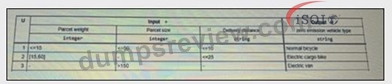
- A. Electric vans are systematically used when the parcel size is larger than 150cm
- B. Electric cargo bikes are never used for short distances
- C. Normal bicycles are mainly used for short trips regardless of the weight of the parcel
- D. When the weight of the parcel exceeds 50kg then the electric cargo bike is necessarily used
Answer: D
Explanation:
Let's analyze the DMN table shown in the image:
Rule 1: If weight #15, size #50, and distance #10 # use Normal bicycle
Rule 2: If weight is between 15 and 60 kg, size #150, and distance #25 # use Electric cargo bike Rule 3: Otherwise # use Electric van Now consider the options:
A: Incorrect - parcel size is not the only determining factor for using electric vans; it's about weight, size, and distance combined.
B: Incorrect - normal bicycles are used only when weight #15 kg, size #50 cm, and distance #10 km - so not just "short trips." C: Incorrect - electric cargo bikes are explicitly used for short trips (#25 km), per Rule 2.
D: Correct - based on the rules, any weight above 15 kg (and up to 60 kg) results in the use of electric cargo bikes. So if weight >50 kg (but #60), cargo bike is still used under the conditions of Rule 2.
Therefore, the most consistent interpretation of the decision model is:
D). When the weight of the parcel exceeds 50kg then the electric cargo bike is necessarily used
NEW QUESTION # 37
For a project to migrate an employee qualification management system to web technologies, the following requirement has been defined REQ 3-12 The system must be able to manage 3 types of users: HR team member with full rights, department manager with consultation and update rights only for members of his/her department, and employee with read-only access to his/her data Which of the following sentences BEST reflects an acceptable acceptance criterion?
- A. The database must use MangoDB
- B. Since I am logged in as a department manager, when I try to access the file of an employee who is not in my department then a message telling me that I do not have access rights is displayed
- C. Security test must be performed to demonstrate that the authentication and rights management system is working properly
- D. The list of employees who are members of a department can only be updated by a person logged as HR
Answer: B
Explanation:
Acceptance criteria should define how the system behaves for a given user story or requirement. They must be precise, testable, and directly traceable to the requirement being verified.
REQ 3-12 describes access control for three user types. Option B is a concrete, scenario-based acceptance criterion that tests the enforcement of access rights - making it an ideal match.
Other options:
A is irrelevant - database technology (MongoDB) is an implementation detail, not a functional criterion.
C is too vague - stating that security tests must be performed doesn't specify expected behavior or outcome.
D is plausible, but option B more directly demonstrates how an actual system behavior validates the requirement.
B). Since I am logged in as a department manager, when I try to access the file of an employee who is not in my department then a message telling me that I do not have access rights is displayed
NEW QUESTION # 38
Which of the following relations between business rule modeling and ATDD is correct?
- A. In ATDD business rule models are defined prior to business process models
- B. Application workflow models facilitate the generation of ATDD acceptance test cases
- C. By writing business rules models, stakeholders commit to the ATDD approach
- D. Business rules are described using the Gherkin language also used in ATDD
Answer: B
Explanation:
In Acceptance Test-Driven Development (ATDD), test cases are derived early and are based on business understanding. Application workflows modeled using BPMN or similar notations provide a clear, visual representation of how a user interacts with a system and which business rules are applied.
Option D is correct because these workflow models help define acceptance test cases by outlining the process paths, user interactions, and decision points. These visual models bridge the gap between business needs and testing.
Other options:
A is incorrect - business rule and process models are created based on need; one doesn't necessarily precede the other.
B is misleading - writing business rule models doesn't imply stakeholder commitment to ATDD.
C is incorrect - Gherkin is used for writing scenarios in BDD/ATDD, but business rules are typically modeled using DMN, not Gherkin.
D). Application workflow models facilitate the generation of ATDD acceptance test cases
NEW QUESTION # 39
......
Get Perfect Results with Premium CTFL-AcT Dumps Updated 80 Questions: https://www.dumpsreview.com/CTFL-AcT-exam-dumps-review.html
Free CTFL-AcT Exam Study Guide for the NEW Dumps Test Engine: https://drive.google.com/open?id=19H9J3qt9Da__9QUeW1FmjEMFElfTlP1R
