

A fully updated 2026 L4M5 Exam Dumps exam guide from training expert DumpsReview
Provides complete coverage of every objective on exam and exam preparation L4M5
One of the key benefits of obtaining the CIPS L4M5 certification is the increased credibility it brings to a procurement or supply chain professional's resume. Commercial Negotiation certification is recognized globally and is highly respected within the industry, giving candidates a competitive edge in the job market. Additionally, the skills and knowledge acquired through the CIPS L4M5 Exam can be applied in a wide range of commercial contexts, making it a valuable certification for professionals in various industries.
NEW QUESTION # 22
The buyer's bargaining power tends to be relatively higher than supplier's bargaining power in which of the following circumstances?
- A. The buyer does not have the option to move to an alternative supplier
- B. The buyer's spend takes up a small proportion of supplier revenue
- C. The buyer is large in size relative to its suppliers
- D. The buyer demand is so urgent that it can't be postponed
Answer: C
Explanation:
:
Buyer power gives customers/consumers (buyers) the ability to squeeze industry margins by pressuring firms (the suppliers) to reduce prices or increase the quality of services or products offered.
There are four major factors to consider when determining the bargaining power of buyers:
1. Number of buyers relative to suppliers: If the number of buyers is small relative to that of suppliers, the buyer's power will be stronger.
2. Dependence of a buyer's purchase on a particular supplier: If a buyer is able to get similar products
/services from other suppliers, buyers depend less on a particular supplier. Therefore, the power of the buyer would be greater.
3. Switching costs: If there are not many alternative suppliers available, the cost of switching is high.
Therefore, buyer power would be low.
4. Backward Integration: If the buyer is able to integrate or merge suppliers, the buyer has greater bargaining power over the existing suppliers.
When is Bargaining Power of Buyers High/Strong?
There are fewer buyers relative to that of suppliers
The switching costs of the buyer are low
If the buyer is able to backward integrate
The buyer purchases product in bulk (high volume)
The buyer is able to get similar product/services from other suppliers
The buyer purchases the majority of the seller's products
Several substitutes are available on the market
Product is not differentiated
NEW QUESTION # 23
Which of the following are microeconomic factors? Select THREE that apply.
- A. Distribution channels
- B. Availability of investors
- C. Rates of taxation
- D. Rates of inflation
- E. Levels of competition
- F. Unemployment levels
Answer: A,B,E
Explanation:
Microeconomic factors refer to elements that affect individual businesses or sectors rather than the economy as a whole. In this case:
Availability of investors (B): Access to investors impacts capital availability for businesses.
Distribution channels (D): Distribution methods directly influence a business's ability to get products to market.
Levels of competition (F): Competition affects pricing and strategic decisions within specific industries.
Taxation rates, unemployment levels, and inflation rates are considered macroeconomic factors, affecting the economy on a broader scale, as per CIPS's definitions of microeconomic vs. macroeconomic influences.
NEW QUESTION # 24
Sunita's supplier states: "Meeting your needs is meeting my needs because we are in this together." What type of negotiation is being undertaken?
- A. Distributive negotiation
- B. Lose-lose negotiation
- C. Adversarial negotiation
- D. Integrative negotiation
Answer: D
Explanation:
This statement reflects shared goals and mutual benefit, hallmarks of integrative negotiation. Unlike adversarial or distributive (win-lose) strategies, integrative approaches seek joint value and collaboration. The language of partnership ("we are in this together") signals alignment and cooperative intent. Lose-lose outcomes, by contrast, occur when both sides compromise excessively or fail to reach creative solutions.
Integrative strategies foster long-term partnerships where value is maximised for both.
Reference: CIPS L4M5 (2nd ed.), LO 1.1 - Integrative negotiation characteristics.
NEW QUESTION # 25
Maria is a professional services category buyer within the National Health Service. Due to severe financial budget cutbacks the National Health Service is facing, the procurement team has been tasked with achieving cost savings so that funding available can be spent on patient care. Maria plans to achieve savings with one of her collaborative suppliers. Which negotiation approach should she undertake?
- A. Win-Lose
- B. Win-Perceived Win
- C. Win-Win
- D. Lose-Lose
Answer: C
Explanation:
Reference: CIPS L4M5 Study Guide, Section 1.2 - Approaches to Negotiation
NEW QUESTION # 26
There are no commitments in hypothetical questions. Is this statement true?
- A. No, because hypothetical questions are made explicitly to the other party
- B. Yes, because hypothetical questions only mention possible situations
- C. Yes, because hypothetical questions generate a specific response
- D. No, because the party who makes hypothetical questions cannot withdraw their proposals
Answer: B
Explanation:
There are four types of questions that can be used in a commercial negotiation:
Hypothetical questions, where you ask about a possible situation or abstract concept, are very useful at the testing and proposal phases. Hypothetical question does not state any commitment as it is only about 'if something happens, then ...'. This type of question can be useful at giving suggestion.
Text Description automatically generated
LO 3, AC 3.3
NEW QUESTION # 27
XYZ Ltd is importing goods from overseas. They prefer to pay their supplier in their own currency. Which of the following is a true statement?
- A. XYZ has to pay more if their currency depreciates
- B. XYZ is able to pay less if their currency depreciates
- C. XYZ has an advantage in negotiating discounts if their currency appreciates
- D. Supplier will receive less if XYZ's currency appreciates
Answer: C
Explanation:
The effect of a change of relative exchange rates will be determined by which currency you pay your supplier in.
Table Description automatically generated
LO 2, AC 2.2
NEW QUESTION # 28
Which of the following is the first step in the development of negotiation strategies?
- A. Recognising TOP's needs and wants
- B. Defining overarching objectives
- C. Developing scenarios around possible options
- D. Determining your BATNA
Answer: B
Explanation:
:
Developing specific negotiation strategies in areas where risk or spend is high involves analysing a wide range of objectives and variables within the context of the organisation's business requirements. The first stage in any negotiation preparation is to define your overall objectives which may be related to a single variable such as price in the case of a standardised requirement, or many variables in the case of capital equipment. Your negotiating strategies and tactics will all be focused on achieving overall objectives.
NEW QUESTION # 29
Jessica Taylor, a senior buyer, is reflecting on her most recent negotiation. She has been asked by her manager to create a written record of performance. Which of the following should Jessica include in this negotiation performance report? Select THREE that apply:
- A. A checklist of for future
- B. Other suppliers that could have been used
- C. Travel expenses to attend the meeting
- D. Evaluation of the negotiator's performance
- E. A comparison of actual versus set objectives
- F. A detailed pricing structure
Answer: D,E,F
NEW QUESTION # 30
Power is used only in adversarial negotiation situations to secure a 'win' outcome against the other side. Is this statement correct?
- A. Yes, all negotiations entail a commercial contest which is always adversarial, as the powerful side gains
- B. No, the use of power can be necessary in integrative negotiations to help overcome time-wasting issues
- C. No, the use of power is not important in commercial negotiations as each side only looks for areas of agreement
- D. Yes, it only in adversarial negotiation that the use of power is necessary, because of the win-lose outcome
Answer: B
Explanation:
Reference: CIPS L4M5 Study Guide, Section 1.2 - Approaches to Negotiation
NEW QUESTION # 31
If the price of a good is above the equilibrium price, which of the following will happen?
- A. The quantity demanded is equal to the quantity supplied and the price remains unchanged
- B. There is a shortage (i.e. an excess demand) and the price will fall
- C. There is a surplus (i.e. an excess supply) and the price will rise
- D. There is a surplus (i.e. an excess supply) and the price will fall
Answer: D
Explanation:
In microeconomics, equilibrium price is determined when the quantity demanded is equal to thequantity supplied at equilibrium price in a market, there will be no shortages and no surpluses. If we combine our supply and demand curves on one graph, the point at which they converge determines the equilibrium price. If the price is set above this price and you read across the graph you will see the supply excess demand and there will be a surplus. In order to reduce this surplus, the price will need to fall. The scenario is illustrated in the graph below:
Chart, line chart Description automatically generated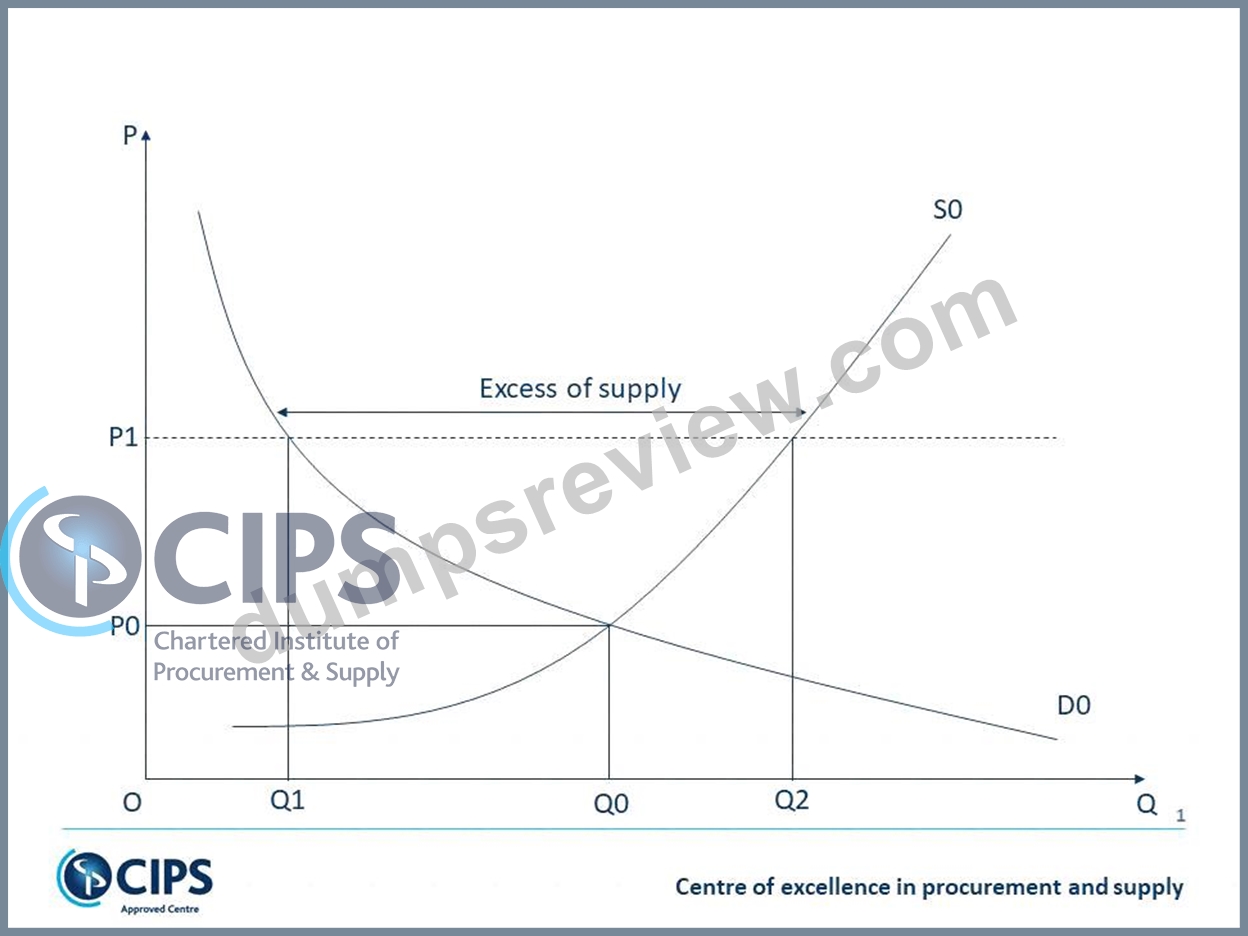
NEW QUESTION # 32
Citywide Developments Ltd (CDL) is a construction programme management company that delivers high- value property development schemes. CDL uses named consultant design services in contracts. Recently, consultancy day rates have increased. Which of the following tradeable concessions could CDL offer when negotiating with suppliers to achieve lower rates, without lowering service quality?
- A. Accept unqualified trainee consultants
- B. Remove the requirement for the named personnel
- C. Offer a shorter consultant working day
- D. Reduce the volume-based rate discounts
Answer: B
Explanation:
By removing the requirement for named personnel, CDL could allow the supplier flexibility in allocating equally competent but possibly less expensive staff. This tradeable does not compromise on quality but helps control costs.
Reference: L4M5 Commercial Negotiation 2nd edition (CORE), Section 3.2 - Using Tradeables in Negotiation
NEW QUESTION # 33
Which of the following types of relationship would possibly lead to a distributive negotiation?
- A. Outsourcing
- B. Partnership
- C. Transactional
- D. Alliance
Answer: C
NEW QUESTION # 34
John Browne, a junior buyer for a corporation, is analysing the global supply market before undertaking negotiations and is wondering whether foreign exchange rates are important to factor into his research. Should John consider the foreign exchange rates?
- A. No, exchange rates only apply to the national economy
- B. Yes, as they can affect profit and turnover
- C. No, as they only affect the bank's interest rates for loans
- D. Yes, only if the organisation can handle foreign currencies in their accounts
Answer: B
Explanation:
Foreign exchange ratesdirectly influence thecost of imported goods and services. Currency fluctuations can affect total expenditure, supplier margins, and ultimately the buyer's profitability. Even if payment is in local currency, suppliers may adjust their pricing to mitigate foreign exchange risks.
"Foreign exchange volatility can significantly impact pricing in international procurement. Buyers must assess currency risks as part of their cost evaluation and strategic preparation." (L4M5 Commercial Negotiation, 2nd edition, Section 2.2 - Macroeconomic Considerations in Pricing)
NEW QUESTION # 35
An organization should develop different relationships which are appropriate to each supplier situation.
Which ONE of the following analysis methods could help to identify these?
- A. A spectrum of non-critical items
- B. Resources and cost spectrum
- C. The relationship spectrum
- D. The color spectrum
Answer: C
Explanation:
The relationship spectrum categorizes supplier relationships based on factors like strategic importance, allowing organizations to tailor their approach to each supplier relationship. CIPS emphasizes the relationship spectrum as a valuable tool for assessing and managing supplier interactions based on strategic relevance.
NEW QUESTION # 36
Buying organisation may increase its leverage with suppliers by concentrating spend. Which of the following are most likely to be forms of supplier spend consolidation? Select THREE that apply.
- A. Forming purchasing consortia
- B. Volume separation
- C. Volume redistribution
- D. Simplify procurement process
- E. Volume consolidation across categories
- F. Paying supplier on time
Answer: A,C,E
Explanation:
:
Buying organisation may increase its leverage with suppliers by concentrating spend. Supplier spend consolidation can take many forms as outlined below:
Vendor base reduction: straightforward reduction of number of suppliers in any category Volume pooling: pooling cross organisational requirement until your order volume is high enough to attract new bidders/additional discounts Volume redistribution: making recommendations following spend analysis to move from one supplier to another Volume consolidation across categories: certain purchase requirements may be common across a number of categories Standardisation and harmonisation of specifications: analysis of specifications and standards for a high spend purchased input, may show that there is a little difference between them and that the specification can be standardised or at least harmonised across the group or across national, regional or global operations.
Forming purchasing consortia: buyers may decide to come together and combine their purchase volumes to attract better deals.
NEW QUESTION # 37
Which of the following will help to indicate personality preferences in four dimensions?
- A. Myers-Briggs Type Indicator
- B. Intelligence quotient
- C. Mill's RESPECT mnemonic
- D. Thomas-Kilmann Conflict Resolution model
Answer: A
Explanation:
:
The Myers-Briggs Type Indicator (MBTI) is an introspective self-report questionnaire indicating differing psychological preferences in how people perceive the world and make decisions. MBTI indicates personality preferences in four dimensions.
The Thomas-Kilmann Conflict Mode Instrument (TKI) is a conflict style inventory, which is a tool developed to measure an individual's response to conflict situations.
Mill's RESPECT mnemonic is set out by Harry A. Mills which describes seven steps to agreements An intelligence quotient (IQ) is a total score derived from a set of standardized tests designed to assess human intelligence.
NEW QUESTION # 38
Which characteristics are likely to feature within an integrative negotiation?
* Maximising the other party's outcome to enhance relationships
* Maximising joint outcomes
* Short-term focus
* Pursuit of goals held jointly with the other party
- A. 2 and 4 only
- B. 1 and 3 only
- C. 1 and 2 only
- D. 3 and 4 only
Answer: A
Explanation:
Integrative negotiation emphasises maximising joint outcomes and pursuing shared goals, moving beyond narrow self-interest. Unlike distributive negotiations, it does not focus on short-term wins or zero-sum positions. Instead, integrative strategies build sustainable value and strengthen partnerships. Maximising the other party's outcome alone is more accommodative than integrative. Therefore, true integrative practice balances both parties' interests for long-term gain.
Reference: CIPS L4M5 (2nd ed.), LO 1.1 - Features of integrative negotiation.
NEW QUESTION # 39
Which of the following would describe a push approach to influencing?
Exerting power or authority
Extensive use of open questioning
The party being influenced is fully aware of the process occurring
The party being influenced may not be aware of the process happening
- A. 1 and 2 only
- B. 3 and 4 only
- C. 2 and 4 only
- D. 1 and 3 only
Answer: D
Explanation:
A push approach typically involves exerting authority or power (1) with the party being influenced generally aware of the influence process (3). This method involves overtly directing or persuading the other party, often through explicit information or directives, as per CIPS's understanding of push influence techniques.
NEW QUESTION # 40
Which type of question is most effective for checking facts in negotiation?
- A. Closed
- B. Open
- C. Leading
- D. Hypothetical
Answer: A
Explanation:
Closed questions (requiring yes/no or factual answers) are best for verifying facts, ensuring clarity and accuracy. Open questions are useful for exploration, while hypothetical test possibilities, and leading steer responses. In negotiation, closed questions confirm details such as prices, quantities, or deadlines, preventing ambiguity in agreements. CIPS stresses using the full range of question types strategically, with closed questions essential in finalising commitments.
Reference: CIPS L4M5 (2nd ed.), LO 3.2 - Questioning techniques: closed vs open vs hypothetical.
NEW QUESTION # 41
Procurement team is required to improve leverage with their suppliers through spend consolidation. To check whether there is any opportunity to consolidate spend, which of the following should be priority of procurement team?
- A. Value engineering
- B. Spend analysis
- C. Total cost analysis
- D. Price analysis
Answer: B
Explanation:
In order to identify opportunities where you can increase your leverage with supplier, you need to understand your spend. Undertaking spend analysis of your accounts payable (AP) data is an essential first step here.
NEW QUESTION # 42
Different types of relationships impact on commercial negotiations. At a negotiation, which one of the following sources would help to support leverage for the buyer?
- A. Personality power
- B. Powerful colleagues
- C. Friends power
- D. Legitimate power
Answer: D
Explanation:
Legitimate poweris derived from theposition or authorityheld within the organisation. It supports the buyer's ability to influence negotiation outcomes based on formal responsibility, legal rights, or contractual mandates.
"Legitimate power stems from formal roles, authority or responsibility. It enables negotiators to assert terms backed by organisational policy or legal mandate." (L4M5 Commercial Negotiation, 2nd edition, Section 3.1 - Organisational Power Structures in Negotiation)
NEW QUESTION # 43
......
CIPS L4M5 Commercial Negotiation exam is an essential component of the CIPS Level 4 diploma in procurement and supply. It tests the candidate's knowledge and skills in commercial negotiation, which is a critical skill for procurement professionals. Passing L4M5 exam demonstrates that the candidate has a solid understanding of negotiation processes, tactics, and strategies, and can apply them effectively in real-world situations. Commercial Negotiation certification is highly valued in the procurement and supply chain industry and can help professionals advance their careers in the field.
Tested Material Used To L4M5: https://www.dumpsreview.com/L4M5-exam-dumps-review.html
Steps Necessary To Pass The L4M5 Exam: https://drive.google.com/open?id=1iDPeI9_JlBnLuCKOzmbkgXtxazCapJMr
