

[Apr-2026] Feel Juniper JN0-336 Dumps PDF Will likely be The best Option
JN0-336 exam torrent Juniper study guide
NEW QUESTION # 20
You have implemented a vSRX in your VMware environment. You want to implement a second vSRX Series device and enable chassis clustering.
Which two statements are correct in this scenario about the control-link settings? (Choose two.)
- A. In the vSwitch security settings, accept promiscuous mode.
- B. In the vSwitch security settings, reject MAC address changes.
- C. In the vSwitch properties settings, set the VLAN ID to None.
- D. In the vSwitch security settings, reject forged transmits.
Answer: A,B
NEW QUESTION # 21
You have deployed an SRX300 Series device and determined that files have stopped being scanned.
In this scenario, what is a reason for this problem?
- A. The software license is a free model and only scans executable type files.
- B. You have exceeded the maximum files submission for your SRX platform size.
- C. The infected host communicated with a command-and-control server, but it did not download malware.
- D. The file is too small to have a virus.
Answer: B
Explanation:
You have exceeded the maximum files submission for your SRX platform size: This statement is correct because file scanning on SRX300 Series device has a limit on the number of files that can be submitted per minute based on the platform size3. For example, SRX320 has a limit of 10 files per minute3.
NEW QUESTION # 22
Which two statements are true about Juniper ATP Cloud? (Choose two.)
- A. Juniper ATP Cloud only uses one antivirus software package to analyze files.
- B. Juniper ATP Cloud does not use antivirus software packages to protect against zero-day threats.
- C. Juniper ATP Cloud uses multiple antivirus software packages to analyze files.
- D. Juniper ATP Cloud uses antivirus software packages to protect against zero-day threats.
Answer: B,C
Explanation:
Two statements that are true about Juniper ATP Cloud are:
Juniper ATP Cloud uses multiple antivirus software packages to analyze files: Juniper ATP Cloud is a cloud-based service that provides advanced threat prevention and detection for your network. It integrates with SRX Series firewalls and MX Series routers to analyze files and network traffic for signs of malicious activity. Juniper ATP Cloud uses multiple antivirus software packages from different vendors to scan files for known malware signatures and provide a comprehensive verdict based on their results.
Juniper ATP Cloud does not use antivirus software packages to protect against zero-day threats: Juniper ATP Cloud protects against zero-day threats by using dynamic analysis, not antivirus software packages.
Dynamic analysis is a method of executing files in a sandbox environment and observing their behavior and network interactions. Dynamic analysis can uncover unknown malware that may evade static analysis or signature-based detection methods.
Reference: = Juniper Advanced Threat Prevention Cloud (ATP Cloud), Juniper Advanced Threat Prevention Cloud | ATP Cloud | Juniper Networks, Breaking Down Security Complexity with Juniper Networks' ATP Cloud
NEW QUESTION # 23
Which two statements are correct about Juniper ATP Cloud? (Choose two.)
- A. Once the target threshold is met, Juniper ATP Cloud continues looking for threats from 0 to 5 minutes.
- B. The threat levels range from 0-100.
- C. The threat levels range from 0-10.
- D. Once the target threshold is met, Juniper ATP Cloud continues looking for threats levels range from 0 to 10 minutes.
Answer: B,C
Explanation:
In many threat intelligence and evaluation systems, including Juniper ATP Cloud, the threat levels are often scored on a scale to provide a quick reference of the potential risk associated with a threat. A common range for these threat levels is from 0 to 10, with 0 representing minimal or no threat and 10 representing a severe threat.
Alternatively, some systems may use a more granular scoring system ranging from 0 to 100, providing a more nuanced assessment of threat levels. This range allows for finer differentiation between the levels of threat severity.
NEW QUESTION # 24
What are two requirements for enabling AppQoE? (Choose two.)
- A. You need two SRX Series or MX Series device endpoints.
- B. You need two SRX Series device endpoints.
- C. You need to configure AppQoE for reverse traffic.
- D. You need an APPID feature license.
Answer: A,D
Explanation:
AppQoE is a feature that enables you to monitor and optimize the quality of experience for applications on your network. It uses application-aware routing and dynamic path selection to choose the best path for each application based on predefined or custom SLA profiles. AppQoE also provides visibility and reporting on application performance and network conditions.
Two requirements for enabling AppQoE are:
You need two SRX Series or MX Series device endpoints: AppQoE can be configured between two SRX Series device endpoints or between an SRX Series device and an MX Series device in a hub-and-spoke or full mesh topology. The devices must run the same version of Junos OS and have the same AppQoE configuration.
You need an APPID feature license: AppQoE requires an APPID feature license to be installed on the SRX Series device. The APPID feature license enables application identification and classification, which are essential for AppQoE to work.
Reference: = Application Quality of Experience Overview, Application Quality of Experience Overview - Juniper Networks, Application Quality of Experience | Junos OS | Juniper Networks
NEW QUESTION # 25
Which two statements are correct about App Track? (Choose two.)
- A. App Track identifies and blocks traffic flows that might be malicious regardless of the ports being used.
- B. App Track can be configured for any defined logical system on an SRX Series device.
- C. App Track can only be configured in the main logical system on an SRX Series device.
- D. App Track collects traffic flow information including byte, packet, and duration statistics.
Answer: B,D
Explanation:
AppTrack is a feature that allows you to monitor and analyze the application traffic on your SRX Series device. It can be configured for any defined logical system, which is a virtual router or switch within a physical device. AppTrack collects statistics such as bytes, packets, and duration for each application flow and displays them in reports or logs. AppTrack does not identify or block malicious traffic, that is the function of AppSecure or IDP/IPS. Reference: = JNCIS-SEC Certification, Open Learning - Security, Specialist (JNCIS-SEC), Application Security Theory
NEW QUESTION # 26
Exhibit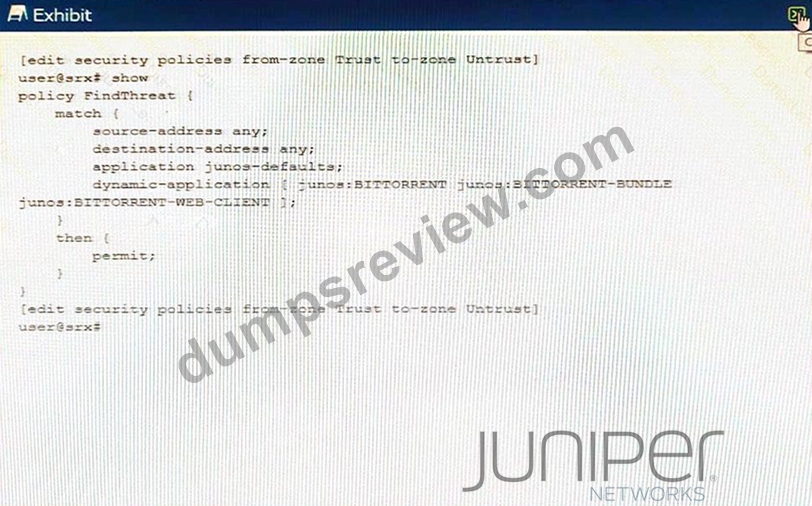
You are asked to track BitTorrent traffic on your network. You need to automatically add the workstations to the High_Risk_Workstations feed and the servers to the BitTorrent_Servers feed automatically to help mitigate future threats.
Which two commands would add this functionality to the FindThreat policy? (Choose two.)
- A.

- B.

- C.

- D.

Answer: A,D
NEW QUESTION # 27
Which statement about security policy schedulers is correct?
- A. A policy without a defined scheduler will not become active
- B. When the scheduler is disabled, the policy will still be available.
- C. A policy can have multiple schedulers.
- D. Multiple policies can use the same scheduler.
Answer: D
Explanation:
Schedulers can be defined and reused by multiple policies, allowing for more efficient management of policy activation and deactivation. This can be particularly useful for policies that need to be activated during specific time periods, such as business hours or maintenance windows.
NEW QUESTION # 28
Which two statements are true about the vSRX? (Choose two.)
- A. UNIX is the base OS.
- B. It has VMXNET3 vNIC support.
- C. Linux is the base OS.
- D. It does not have VMXNET3 vNIC support.
Answer: B,C
NEW QUESTION # 29
You want to permit access to an application but block application sub.
Which two security policy features provide this capability? (Choose two.)
- A. content filtering
- B. URL filtering
- C. micro application detection
- D. APPID
Answer: C,D
Explanation:
Micro application detection is a feature that enables more granular control over applications by identifying and taking action on sub-features or specific behaviors within an application. For example, allowing access to Facebook while blocking Facebook Chat.
Application Identification (APPID) is a feature that identifies and controls applications based on their traffic patterns and characteristics. APPID can be configured to recognize not only the main application but also its various subcomponents, allowing for precise control over what is allowed or blocked.
NEW QUESTION # 30
Which solution enables you to create security policies that include user and group information?
- A. Network Director
- B. NETCONF
- C. JIMS
- D. ATP Appliance
Answer: C
Explanation:
The solution that enables you to create security policies that include user and group information is JIMS (Juniper Identity Management Service). JIMS collects and maintains a large database of user, device, and group information from Active Directory domains or syslog sources, and enables SRX Series devices to rapidly identify thousands of users in a large, distributed enterprise. With JIMS, you can create security policies that include user and group information, and enforce user-based access control policies to protect network resources.
NEW QUESTION # 31
You are troubleshooting unexpected issues on your JIMS server due to out of order event log timestamps.
Which action should you take to solve this issue?
- A. Enable time synchronization on the client devices.
- B. Enable time synchronization on the JIMS server.
- C. Enable time synchronization on the domain controllers.
- D. Enable time synchronization on the SRX Series devices.
Answer: C
Explanation:
To solve the issue of out of order event log timestamps on your JIMS server, you should enable time synchronization on the domain controllers. JIMS (Juniper Identity Management Service) is a Windows service that collects user, device, and group information from Active Directory domains or syslog sources and provides it to SRX Series devices and CSO for identity-based security policies. JIMS relies on the timestamps of the event logs generated by the domain controllers to track user logins, logouts, and IP address changes. If the domain controllers have different or inaccurate clocks, the event logs may have out of order or incorrect timestamps, which can cause JIMS to miss or misinterpret some events and affect its accuracy and performance. Therefore, you should ensure that all the domain controllers in your network are synchronized with a reliable time source, such as an NTP server or a Windows Time service. Reference: = Juniper Identity Management Service User Guide, Juniper Identity Management Service Feature Guide, Configure JIMS Collector to Get Microsoft Event Logs, Considerations for timestamps in centralized logging platforms
NEW QUESTION # 32
You want to use IPS signatures to monitor traffic.
Which module in the AppSecure suite will help in this task?
- A. AppTrack
- B. AppQoS
- C. APPID
- D. AppFW
Answer: D
Explanation:
The AppFW module in the AppSecure suite provides IPS signatures that can be used to monitor traffic and detect malicious activities. AppFW also provides other security controls such as Web application firewall, URL filtering, and application-level visibility.
NEW QUESTION # 33
While working on an SRX firewall, you execute the show security policies policy-name <name> detail command.
Which function does this command accomplish?
- A. It shows the system log files for the local SRX Series device.
- B. It shows policy counters for a configured policy.
- C. It displays details about the default security policy.
- D. It identifies the different custom policies enabled.
Answer: B
Explanation:
The function that the show security policies policy-name <name> detail command accomplishes is showing policy counters for a configured policy. Policy counters are statistics that indicate how many times a policy has been matched by traffic and what actions have been taken by the policy. Policy counters can help you monitor and troubleshoot the performance and effectiveness of your security policies. The show security policies policy-name <name> detail command displays detailed information about a specific policy, such as its source zone, destination zone, description, state, hit count, byte count, packet count, action count, and session count.
Reference: = show security policies, show security policies information, [SRX] How to troubleshoot a security policy that is not passing data
NEW QUESTION # 34
Which two sources are used by Juniper Identity Management Service (JIMS) for collecting username and device IP addresses? (Choose two.)
- A. DNS
- B. OpenLDAP service ports
- C. Active Directory domain controller event logs
- D. Microsoft Exchange Server event logs
Answer: A,C
Explanation:
Juniper Identity Management Service (JIMS) collects username and device IP addresses from both DNS and Active Directory domain controller event logs. DNS is used to resolve hostnames to IP addresses, while Active Directory domain controller event logs are used to get information about user accounts, such as when they last logged in.
NEW QUESTION # 35
......
Use Valid New JN0-336 Test Notes & JN0-336 Valid Exam Guide: https://www.dumpsreview.com/JN0-336-exam-dumps-review.html
JN0-336 Actual Questions Answers PDF 100% Cover Real Exam Questions: https://drive.google.com/open?id=1CXe0os5bc6fYSNgLUqqwVGbb5juqpqD-
