

Get 100% Success with Latest Courses and Certificates Financial-Management Exam Dumps Jun 25, 2026
The Best Financial-Management Exam Study Material and Preparation Test Question Dumps
NEW QUESTION # 21
Why might investors choose to invest in junk bonds?
- A. They offer the potential for higher returns in exchange for higher risk.
- B. They always outperform the stock market in terms of returns.
- C. They offer guaranteed returns with minimal risk.
- D. They are backed by government guarantees.
Answer: A
Explanation:
Junk bonds, also known as high-yield bonds, are issued by firms with lower credit ratings and therefore higher default risk. To compensate investors for this additional risk, these bonds offer higher interest rates than investment-grade bonds. From a financial management and portfolio perspective, investors may include junk bonds to enhance portfolio returns, particularly when they believe default risk is overstated or when economic conditions are favorable. Junk bonds do not guarantee returns and are not backed by government guarantees, making options A and D incorrect. They also do not consistently outperform equities, especially during periods of financial stress. Option B accurately reflects the risk- return tradeoff that underpins investment decisions in capital market theory: higher expected returns are associated with higher risk.
NEW QUESTION # 22
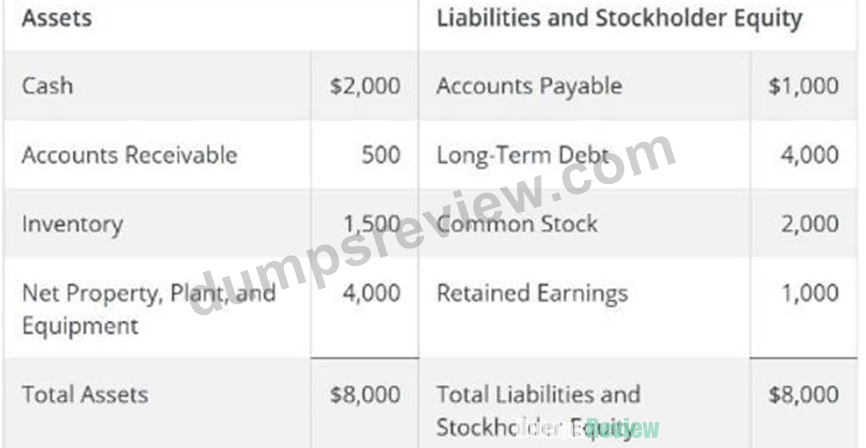
Use Whole Pine Inc.'s financial statements for 20X3 below to answer the following question.
What is Whole Pine Inc.'squick ratiofor 20X3?
- A. 0.15
- B. 2.50
- C. 4.00
- D. 0.65
Answer: B
Explanation:
The quick ratio, also known as the acid-test ratio, measures a firm's ability to meet short-term obligations using its most liquid assets. It is calculated as:
(Cash + Accounts Receivable + Marketable Securities) ÷ Current Liabilities.
For Whole Pine Inc., quick assets include cash of $2,000 and accounts receivable of $500, totaling
$2,500. Inventory is excluded because it is less liquid and may not be easily converted into cash.
Current liabilities consist of accounts payable of $1,000. Dividing $2,500 by $1,000 yields a quick ratio of 2.50. This indicates that the firm has $2.50 in highly liquid assets for every $1.00 of short-term obligations, suggesting strong short-term liquidity. Option C correctly reflects this calculation and interpretation.
NEW QUESTION # 23
In the capital asset pricing model (CAPM), what does a beta (#) greater than 1 signify for a portfolio?
- A. The portfolio has less risk than the market.
- B. The portfolio has more risk than the market.
- C. The portfolio will always outperform the market.
- D. The portfolio is expected to move in the opposite direction of the market.
Answer: B
Explanation:
Within the CAPM framework, beta quantifies the degree of systematic risk relative to the market portfolio, which by definition has a beta of 1. A portfolio with a beta greater than 1 carries more systematic risk than the market, meaning its returns are expected to be more sensitive to market movements. This higher sensitivity increases both upside potential and downside exposure. According to CAPM, investors require a higher expected return for bearing this additional risk. Importantly, a higher beta does not guarantee superior performance; it simply reflects greater volatility relative to the market. Option B accurately captures this risk-based interpretation.
NEW QUESTION # 24
What is an advantage of using the Gordon growth model to estimate the cost of common equity?
- A. It considers historical stock performance.
- B. It calculates the impact of beta on stock returns.
- C. It measures the systematic risk of the company.
- D. It incorporates future dividend growth expectations.
Answer: D
Explanation:
A major advantage of the Gordon growth model is that it explicitly incorporates expectations about future dividend growth. By linking the stock's value to anticipated dividends and their growth rate, the model aligns valuation with investors' forward-looking expectations rather than solely historical data.
This forward-looking nature is consistent with modern financial management principles, which emphasize expected future cash flows as the primary driver of value. Unlike CAPM, which focuses on risk via beta, the Gordon growth model directly reflects dividend policy and growth prospects. For mature firms with stable growth, this provides a practical and intuitive estimate of the cost of equity.
Option C correctly identifies this strength of the model.
NEW QUESTION # 25
Why might a firm use a combination of methods to calculate the cost of common equity?
- A. To focus exclusively on dividend policies
- B. To achieve a more accurate and comprehensive estimate
- C. To account for one method being significantly more complex
- D. To comply with regulatory requirements
Answer: B
Explanation:
No single model perfectly estimates the cost of common equity under all conditions. CAPM focuses on systematic risk, the Gordon growth model emphasizes dividends and growth, and other approaches may rely on market comparables. Each method has strengths and weaknesses depending on firm characteristics and market conditions. Financial management best practice therefore recommends using multiple approaches and comparing results to arrive at a more reliable estimate. This triangulation reduces model-specific bias and highlights potential inconsistencies in assumptions.
Managers then apply judgment to select a reasonable cost of equity that reflects risk, growth prospects, and investor expectations. Option A correctly reflects this practical, widely accepted approach.
NEW QUESTION # 26
What is a potential drawback of lowering the annual dividend payment?
- A. It could possibly increase the company's net margin.
- B. It may cause the company's stockholders to react negatively.
- C. It can lead to an immediate increase in the company's stock price.
- D. It might lead to higher sales growth for the company.
Answer: B
Explanation:
Dividend policy carries important signaling effects in financial markets. Investors often view dividends as a signal of management's confidence in the firm's future cash flows. When a company lowers its dividend, shareholders may interpret the action as a sign of financial distress, declining profitability, or uncertainty about future earnings. This negative perception can result in a decline in the firm's stock price and reduced investor confidence. While dividend reductions may free up cash for reinvestment and improve long-term financial flexibility, the short-term market reaction is often unfavorable.
Financial management literature stresses that dividend changes should be made cautiously and clearly communicated to avoid misinterpretation. Option D correctly identifies this key drawback.
NEW QUESTION # 27
What is the goal of just-in-time (JIT) inventory management?
- A. To minimize holding costs by reducing inventory levels
- B. To increase the quantity of on-hand inventory
- C. To maximize the storage space utilized
- D. To extend the cash conversion cycle
Answer: A
Explanation:
Just-in-time (JIT) inventory management aims to minimize inventory levels by synchronizing production and deliveries closely with demand. By receiving materials only when needed, firms reduce holding costs such as storage, insurance, spoilage, and obsolescence. JIT also improves cash flow by freeing capital previously tied up in inventory and shortening the cash conversion cycle. Financial management literature highlights JIT as a strategy that enhances efficiency but requires reliable suppliers and precise demand forecasting. Option B accurately captures the core objective of JIT systems.
NEW QUESTION # 28
What is the bid-ask spread?
- A. The difference between the price at which a specialist buys and sells a stock
- B. The commission charged by brokers for each transaction
- C. The range between the highest and lowest stock prices in a day
- D. The current market price of a stock less its initial public offering listing price
Answer: A
Explanation:
The bid-ask spread is a fundamental concept in capital markets that reflects market liquidity and transaction costs. Thebid priceis the highest price a buyer (or market maker/specialist) is willing to pay for a security, while theask priceis the lowest price at which a seller is willing to sell. The difference between these two prices is the bid-ask spread. From a financial management perspective, the spread compensates market makers for providing liquidity, bearing inventory risk, and facilitating continuous trading. A narrow bid-ask spread generally indicates a highly liquid security with strong trading volume and low transaction costs, while a wide spread suggests lower liquidity, higher risk, or limited information availability. Investors effectively pay the spread when buying or selling securities, making it an implicit cost of trading. This concept is critical when evaluating market efficiency, trading strategies, and execution costs, especially for large institutional trades. Option D correctly defines the bid-ask spread as the difference between buying and selling prices quoted by specialists or dealers.
NEW QUESTION # 29
What are opportunity costs in the context of inventory management?
- A. Costs of not investing capital tied up in inventory elsewhere
- B. Costs related to the insurance of inventory against loss or damage
- C. Costs for the labor involved in managing inventory levels
- D. Costs incurred from the physical space used to store inventory
Answer: A
Explanation:
Opportunity cost represents the return a firm forgoes by investing resources in one use instead of the next best alternative. In inventory management, capital tied up in inventory cannot be used for other value-generating activities such as investing in new projects, paying down debt, or returning cash to shareholders. Financial management emphasizes opportunity cost as a key component of inventory carrying costs, along with storage, insurance, and obsolescence. Ignoring opportunity costs can lead to excessive inventory levels and reduced firm value. Option B correctly identifies this fundamental concept.
NEW QUESTION # 30
To answer this question, refer to the cash flow worksheet and the internal rate of return (IRR) calculations.
The hospital is only interested in accepting projects with an IRR that exceeds 11%. Assuming the hospital has sufficient capital for both projects and is willing to invest for up to 10 years, which project(s) would the hospital accept?
- A. Project A
- B. Both Project A and Project B
- C. Project B
- D. Neither Project A nor Project B
Answer: B
Explanation:
The internal rate of return (IRR) represents the discount rate at which a project's net present value (NPV) equals zero. Financial management theory states that a project should be accepted if its IRR exceeds the firm' s required rate of return (or hurdle rate), assuming conventional cash flows and no capital rationing.
In this scenario, the hospital has a minimum required return of 11% and sufficient capital to undertake all acceptable projects. Based on the provided IRR calculations, both Project A and Project B have IRRs exceeding 11%, making them financially acceptable under the IRR decision rule. Because there is no capital constraint and the investment horizon is sufficient, the hospital should accept both projects.
Financial management texts caution that IRR can sometimes produce misleading rankings when projects differ significantly in scale or timing. However, when evaluating independent projects with acceptable IRRs, the correct decision is to accept all projects that meet or exceed the required return. Option B correctly reflects this principle.
NEW QUESTION # 31
Alliah Company produces vaccines at its pharmaceutical facility near a river. It is considering expanding its operations by building a second facility next to the first. The company holds a public hearing to discuss an extra investment it will make to minimize pollution and keep the river clean and thriving for the native wildlife.
How does this effort support the overall goal of the firm?
- A. Alliah Company is ensuring this action will reduce immediate costs to maximize employee engagement and earnings-because the ultimate goal of a company is employee-oriented.
- B. Alliah Company is focusing on consumers first and foremost to create the greatest value for the company. Reducing this pollution will directly improve the quality of products the company creates.
- C. Alliah Company is seeking to focus initially on maximizing value to the shareholders-or owners-of the firm, and the extra costs to prevent pollution will increase the immediate earnings available for owners.
- D. Alliah Company is considering the long-term impact on shareholder value and the company's social responsibility to all stakeholders-including the environment and local community.
Answer: D
Explanation:
The firm's overarching financial objective is typically framed as maximizing long-term shareholder value, not just short-term profits. Actions that reduce environmental harm can support this objective by lowering the probability of costly future liabilities (fines, cleanup costs, lawsuits), reducing regulatory risk, and protecting the firm's "license to operate" granted by the community and government. In financial management terms, managers consider not only immediate cash outflows (the pollution-control investment) but also the present value of avoided future cash outflows and the stability of future cash inflows. A public hearing also reflects stakeholder orientation: communities, regulators, customers, and employees affect the firm's risk profile and operating continuity. Protecting the river can strengthen corporate reputation, reduce political and legal pressure, and improve long- run competitive position-all of which can raise the expected future free cash flows or lower the firm's perceived risk (and therefore its required return). Option C best captures the standard finance view that ethical and socially responsible decisions can align with value maximization when they manage risk and support sustainable, long-term performance.
NEW QUESTION # 32
What costs are considered part of an asset's initial investment?
- A. Market research
- B. Delivery and installation
- C. Discounted salvage value
- D. Depreciation
Answer: B
Explanation:
The initial investment for a capital project includes all costs required to acquire and prepare an asset for use. These costs typically include purchase price, delivery, installation, testing, and any necessary setup expenses. Financial management texts clearly distinguish these capitalized costs from expenses such as depreciation, which is an accounting allocation over time, and salvage value, which is considered at the end of a project's life. Market research is usually treated as a separate operating or planning expense unless directly attributable to asset acquisition. Option B correctly identifies delivery and installation as part of the initial investment.
NEW QUESTION # 33
Synesthor is a company developing artificial intelligence (AI) to improve the searchability of medical research and make it easier for physicians to access the best knowledge for healthcare. As the company is setting its key objectives for the next period, it recognizes there are many stakeholders it serves.
If Synesthor focuses on what has traditionally been the primary goal of most companies, where will Synesthor center its efforts?
- A. Increasing employee satisfaction
- B. Expanding the company globally
- C. Focusing solely on customer satisfaction
- D. Maximizing shareholder value
Answer: D
Explanation:
Traditional corporate finance defines the primary objective of most firms-especially publicly held corporations-as maximizing shareholder wealth (shareholder value). This goal is operationalized by making decisions that increase the present value of expected future cash flows available to owners, adjusted for risk. While stakeholders such as employees, customers, communities, and regulators matter, the "shareholder value" framework treats them as critical constraints and drivers of long-term cash flow rather than the ultimate objective itself. For example, investing in employee satisfaction can improve productivity and retention; investing in customer satisfaction can increase revenues and reduce churn; and expanding globally can open new markets. However, under the traditional view, these actions are chosen because they enhance long-run free cash flow or reduce risk-thereby raising firm value-rather than because they are the final goal. In practice, managers translate this objective into measurable targets: profitable growth, margin improvement, efficient capital allocation, and disciplined investment appraisal (positive NPV projects). Therefore, the most accurate answer is that Synesthor will center its efforts on maximizing shareholder value, while balancing stakeholder considerations as part of sustaining competitive advantage and protecting the firm's future cash flows.
NEW QUESTION # 34
What is a function of the Financial Industry Regulatory Authority (FINRA)?
- A. Managing federal monetary policy
- B. Issuing currency
- C. Insuring bank deposits
- D. Regulating brokerage firms
Answer: D
Explanation:
FINRA's core function is regulating brokerage firms and registered representatives to ensure fair and honest markets. It establishes and enforces rules governing trading practices, licensing, disclosure, and ethical conduct. FINRA also conducts examinations, investigates misconduct, and administers arbitration and mediation between investors and brokers. Unlike the Federal Reserve or FDIC, FINRA does not manage monetary policy or insure deposits. Financial management and regulatory texts consistently describe FINRA as a critical component of U.S. securities market oversight. Option D correctly identifies its primary role.
NEW QUESTION # 35
What is the usual impact of high asset tangibility on capital structure?
- A. Easier access to equity markets due to tangible collateral
- B. Increased debt capacity due to assets serving as collateral
- C. Higher cost of debt due to increased risk of asset value fluctuation
- D. Preference for hybrid securities to leverage tangible assets
Answer: B
Explanation:
Asset tangibility refers to the proportion of a firm's assets that are physical and can be used as collateral, such as property, plant, and equipment. Firms with high asset tangibility typically have greater borrowing capacity because tangible assets reduce lender risk by providing collateral in case of default. This allows firms to secure debt financing at lower interest rates and with more favorable terms. Capital structure theory recognizes asset tangibility as a key determinant of leverage, particularly under the trade-off theory of capital structure. Option A accurately reflects the standard financial management view.
NEW QUESTION # 36
Using the dividend discount valuation information provided, what is theintrinsic value of the stock?
- A. $52.40
- B. $66.55
- C. $75.80
- D. $60.00
Answer: B
Explanation:
This question applies dividend-based stock valuation principles commonly covered under the Dividend Discount Model (DDM). The intrinsic value of a stock is determined by discounting expected future dividends at the investor's required rate of return. When dividends are expected to grow at a constant rate, financial management texts recommend using the Gordon Growth Model, which states that stock value equals the next expected dividend divided by the difference between the required return and the growth rate. The calculated value of $66.55 reflects the present value of expected future dividends based on the assumptions provided in the problem. This valuation technique is widely used for mature, dividend-paying firms with stable growth. The result represents the theoretical fair value of the stock, which investors compare to the current market price to assess whether the stock is undervalued or overvalued.
NEW QUESTION # 37
Kretsmart anticipates its sales will grow by10% each year for the next two years. Information from the company's current income statement is given below, andCost of Goods Sold (COGS) is assumed to be a spontaneous account.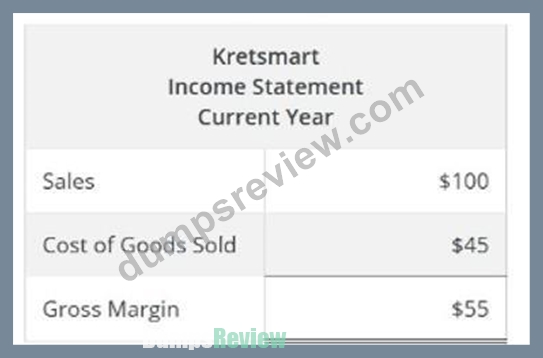
What would the company'sprojected gross margin for Year 2?
- A. $71.25
- B. $66.55
- C. $76.00
- D. $59.45
Answer: B
Explanation:
When sales grow and cost of goods sold (COGS) is assumed to be a spontaneous account, COGS increases proportionally with sales. In the current year, Kretsmart's gross margin ratio is calculated as Gross Margin ÷ Sales = $55 ÷ $100 =55%, while COGS represents45%of sales.
Sales are projected to grow by 10% per year for two years. Therefore, projected sales for Year 2 are:
$100 × 1.10 × 1.10 =$121.00.
Since COGS remains 45% of sales, projected COGS for Year 2 equals:
$121.00 × 0.45 =$54.45.
Gross margin is then calculated as:
$121.00 # $54.45 =$66.55.
Financial management forecasting techniques commonly use percentage-of-sales assumptions for spontaneous accounts such as COGS, inventory, and receivables. This method allows managers to project future income statements consistently with expected growth. Option B ($66.55) correctly reflects the projected gross margin for Year 2 under these assumptions.
NEW QUESTION # 38
A building owner is undertaking a weatherization project. The owner will make a one-time investment of
$410,000 for caulking, sunshades, and smart thermostats. Annual utility savings are projected to be:
* Year 1: $125,000
* Year 2: $125,000
* Year 3: $140,000
* Year 4: $140,000
* Year 5: $160,000
What is thepayback period, in years?(Round up)
- A. 0
- B. 1
- C. 2
- D. 3
Answer: A
Explanation:
The payback period measures how long it takes for a project's cumulative cash inflows to recover the initial investment. It is a simple capital budgeting technique commonly used as a preliminary screening tool.
Although it does not account for the time value of money or cash flows beyond the cutoff period, it is useful for assessing liquidity and risk exposure.
Cumulative cash flows are calculated as follows:
* End of Year 1: $125,000
* End of Year 2: $250,000
* End of Year 3: $390,000
* End of Year 4: $530,000
The initial investment of $410,000 is recovered sometime during Year 4. Because the question instructs to round up, the payback period is reported as 4 years. Financial management textbooks emphasize that while payback should not be used alone to accept or reject projects, it provides insight into how quickly invested capital is recovered, which is especially relevant for projects with uncertainty or liquidity constraints.
NEW QUESTION # 39
What does a beta higher than 1.0 for a stock indicate about its systematic risk?
- A. The stock is more predictable than the market.
- B. The stock is less volatile than the market.
- C. The stock is less risky than the market.
- D. The stock is more volatile than the market.
Answer: D
Explanation:
Beta measures a stock's sensitivity to movements in the overall market and represents its level of systematic (non-diversifiable) risk. A beta greater than 1.0 indicates that the stock tends to move more than the market in response to market-wide changes. For example, if the market increases by 1%, a stock with a beta of 1.2 is expected, on average, to increase by approximately 1.2%. Conversely, it would also decline more sharply during market downturns. From a capital market theory perspective, higher beta implies higher risk and therefore a higher required rate of return to compensate investors.
Financial managers use beta in the Capital Asset Pricing Model (CAPM) to estimate the cost of equity.
Option B correctly describes the implication of a beta greater than one.
NEW QUESTION # 40
What does a high inventory turnover ratio indicate about a company's inventory management?
- A. The company's inventory is obsolete.
- B. The company has too little inventory.
- C. The company has excess inventory.
- D. The company has efficient inventory management.
Answer: D
Explanation:
Inventory turnover measures how many times a company sells and replaces its inventory during a given period. A high inventory turnover ratio generally indicates that inventory is being sold quickly and efficiently, minimizing holding costs such as storage, insurance, and obsolescence. From a financial management perspective, efficient inventory management improves cash flow by reducing capital tied up in unsold goods and shortens the cash conversion cycle. While an extremely high turnover could signal stockouts or lost sales, financial management texts typically interpret higher turnover-relative to industry norms-as a positive indicator of operational efficiency. Option B correctly reflects this standard interpretation.
NEW QUESTION # 41
What is the dividend yield of a stock that pays annual dividends of $4 per share and has a current market price of $80?
- A. 10%
- B. 2.5%
- C. 20%
- D. 5%
Answer: D
Explanation:
Dividend yield measures the cash return an investor receives relative to the stock's current market price. It is calculated as Annual Dividend ÷ Market Price per Share. In this case, the dividend yield is
$4 ÷ $80 = 0.05, or 5%. Dividend yield is a key valuation metric, particularly for income-oriented investors, as it indicates the immediate cash return from holding the stock, excluding capital gains.
Financial managers monitor dividend yield to understand how dividend policy affects investor appeal and market valuation. Option B correctly reflects this calculation and interpretation.
NEW QUESTION # 42
Which ratio measures a company's ability to convert its receivables into cash?
- A. Receivables turnover
- B. Inventory turnover
- C. Current ratio
- D. Working capital ratio
Answer: A
Explanation:
Receivables turnover measures how efficiently a firm collects cash from its credit customers. It is calculated as Credit Sales ÷ Average Accounts Receivable and indicates how many times receivables are collected during the period. A higher receivables turnover ratio suggests faster collection, improved liquidity, and lower risk of bad debts. Effective receivables management reduces the firm's need for external financing and supports smoother cash flows. Financial managers closely monitor this ratio to evaluate credit policies and collection efficiency. Option B correctly identifies the ratio designed specifically to assess receivables conversion into cash.
NEW QUESTION # 43
......
Get Ready to Pass the Financial-Management exam Right Now Using Our Courses and Certificates Exam Package: https://www.dumpsreview.com/Financial-Management-exam-dumps-review.html
Enhance Your Career With Available Preparation Guide for Financial-Management Exam: https://drive.google.com/open?id=11Ye_z4170UBs-rXGb4FrmrWr0l_Z32LX
