

[Oct 03, 2025] AZ-120 Ultimate Study Guide - DumpsReview
Ultimate Guide to Prepare AZ-120 Certification Exam for Microsoft Azure in 2025
Target Audience
The target audience for the Microsoft AZ-120: Planning & Administering Microsoft Azure for SAP Workloads exam includes engineers and architects. These specialists have advanced knowledge and experience with the SAP system landscape. They also possess an understanding of the industry standards, which are explicit for the long-term functioning of the SAP solution within Microsoft Azure. These professionals are responsible for adjusting resources and recommending services as suitable for optimal performance, resiliency, provision, monitoring, size, and scale. They collaborate with the clients, Cloud DBAs, and Cloud administrators to implement specific solutions.
Conclusion
Becoming an SAP Workload professional and gaining great recognition is possible with the Microsoft AZ-120 exam. Using a strict structure, this test validates a huge pool of SAP Workloads and Microsoft Azure skills. However, one must always refer to verified and updated study resources to come up with flying colors in such validation. So, attend the official training proffered by the vendor and enjoy your exam success.
NEW QUESTION # 67
For each of the following statements, select Yes if the statement is true. Otherwise, select No.
NOTE: Each correct selection is worth one point.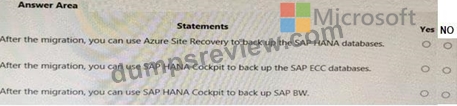
Answer:
Explanation:
Explanation
YES
YES
NO
NEW QUESTION # 68
Your company has an SAP environment that contains the following components:
* SAP systems based on SAP HANA and SAP Adaptive Server Enterprise (SAP ASE) that run on SUSE
* Linux Enterprise Server 12 (SLES 12)
* Multiple SAP applications
The company plans to migrate all the applications to Azure.
You need to get a comprehensive list of all the applications that are part of the SAP environment.
What should you use?
- A. the SAP Solution Manager
- B. the data volume management report
- C. the SAP license information
- D. the network inventory and locations
Answer: A
Explanation:
The SAP Solution Manager is a centralized robust application management and administration solution used to implement, support, operate and monitor your SAP enterprise solutions, SAP Solution Manager is a platform providing integrated content, tools, methodologies and access to SAP systems.
NEW QUESTION # 69
You have an on-premises network and an Azure subscription.
You plan to deploy a standard three-tier SAP architecture to a new Azure virtual network.
You need to configure network isolation for the virtual network. The solution must meet the following requirements:
* Allow client access from the on-premises network to the presentation servers.
* Only allow the application servers to communicate with the database servers.
* Only allow the presentation servers to access the application servers.
* Block all other inbound traffic.
What is the minimum number of network security groups (NSGs) and subnets required? To answer, drag the appropriate number to the correct targets. Each number may be used once, more than once, or not at all. You may need to drag the split bar between panes or scroll to view content.
NOTE Each correct selection is worth one point.
Answer:
Explanation:
Explanation: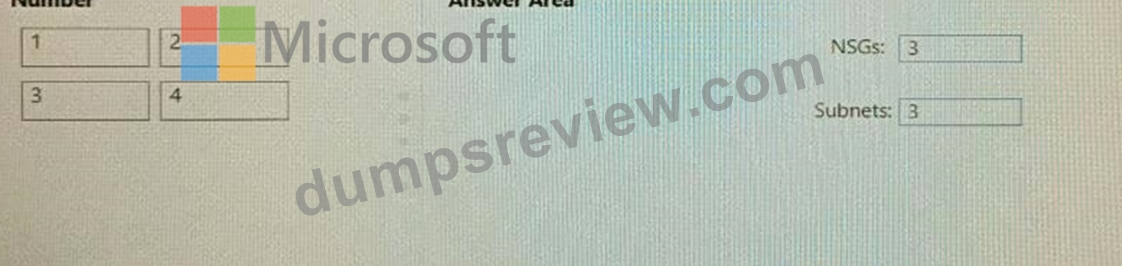
NEW QUESTION # 70
You have a large and complex SAP environment on Azure.
You are designing a training landscape that will be used 10 times a year.
You need to recommend a solution to create the training landscape. The solution must meet the following requirements:
* Minimize the effort to build the training landscape.
* Minimize costs.
In which order should you recommend the actions be performed for the first training session? To answer, move all actions from the list of actions to the answer area and arrange them in the correct order.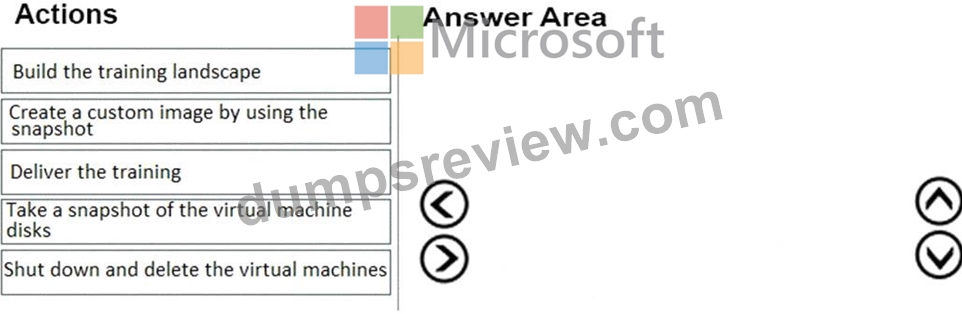
Answer:
Explanation: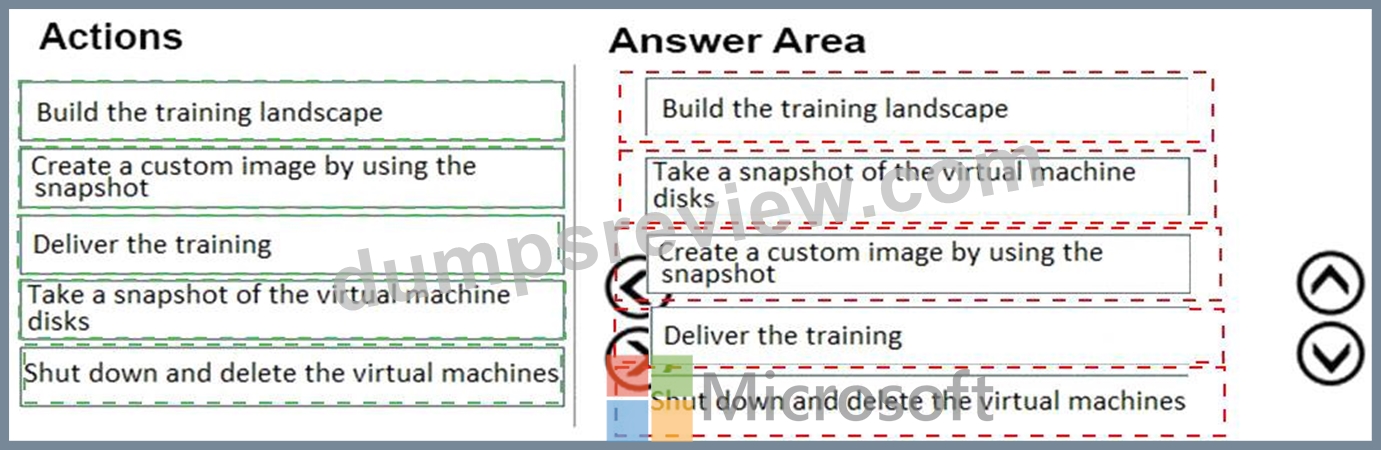
Explanation:
Build
Snapshot
Custom Image
Deliver Training
Shutdown
References:
https://docs.microsoft.com/en-us/azure/virtual-machines/workloads/sap/planning-guide
NEW QUESTION # 71
You have an Azure virtual machine named VM1 that runs SUSE Linux Enterprise Server (SLE5) and hosts an SAP NetWeaver application server.
You need to install the Azure VM extension for SAP solutions on VM1.
Which three actions should you perform in sequence? To answer, move all actions from the list of actions to the answer area and arrange them in the correct order.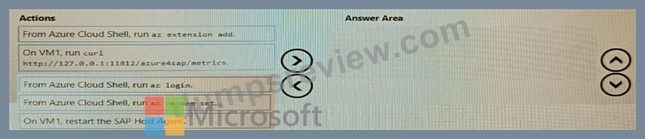
Answer:
Explanation: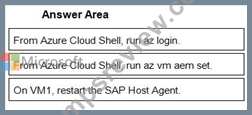
1 - From Azure Cloud Shell, run az login.
2 - From Azure Cloud Shell, run az vm aem set.
3 - On VM1, restart the SAP Host Agent.
NEW QUESTION # 72
You have an Azure alert rule and action group as shown in the following exhibit.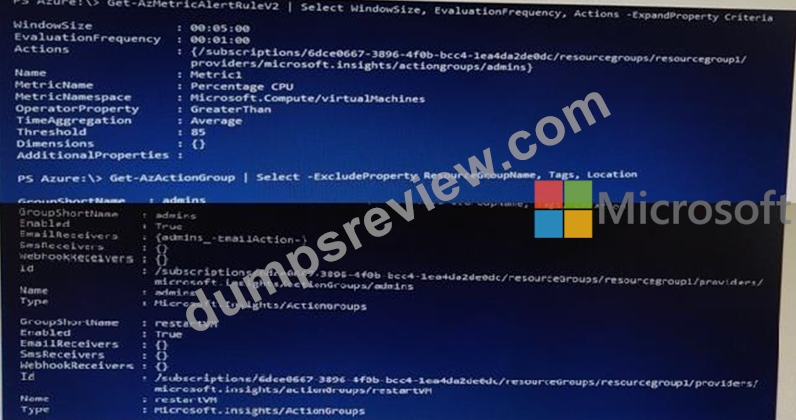
Use the drop-down menus to select the answer choice that completes each statement based on the information presented in the graphic.
NOTE: Each correct selection is worth one point.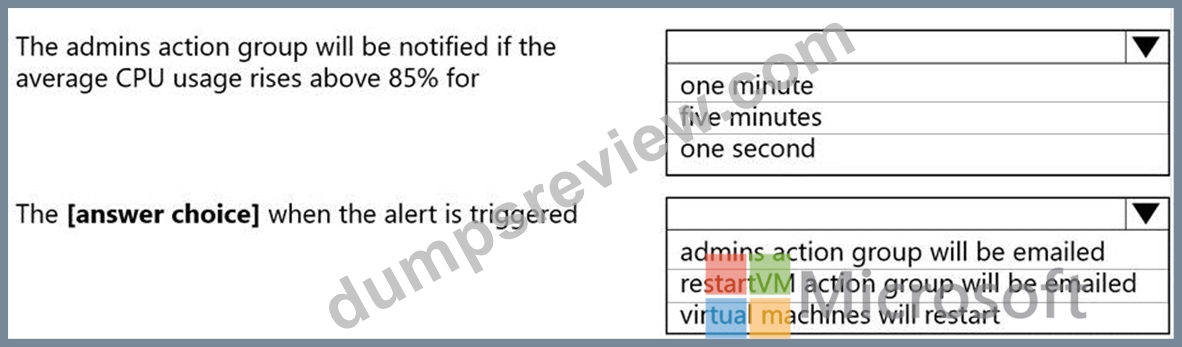
Answer:
Explanation: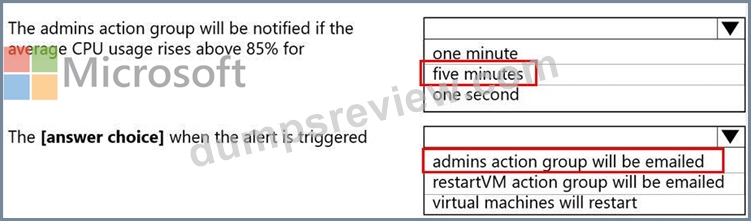
Reference:
https://docs.microsoft.com/en-us/azure/azure-monitor/alerts/alerts-metric-overview
NEW QUESTION # 73
For each of the following statements, select Yes if the statement is true. Otherwise, select No.
NOTE: Each correct selection is worth one point.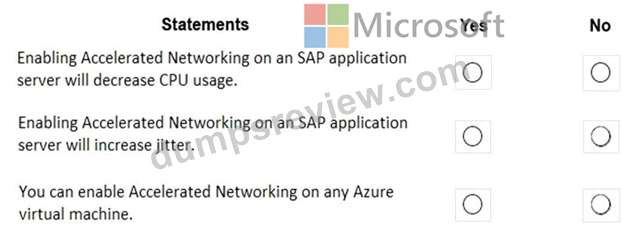
Answer:
Explanation: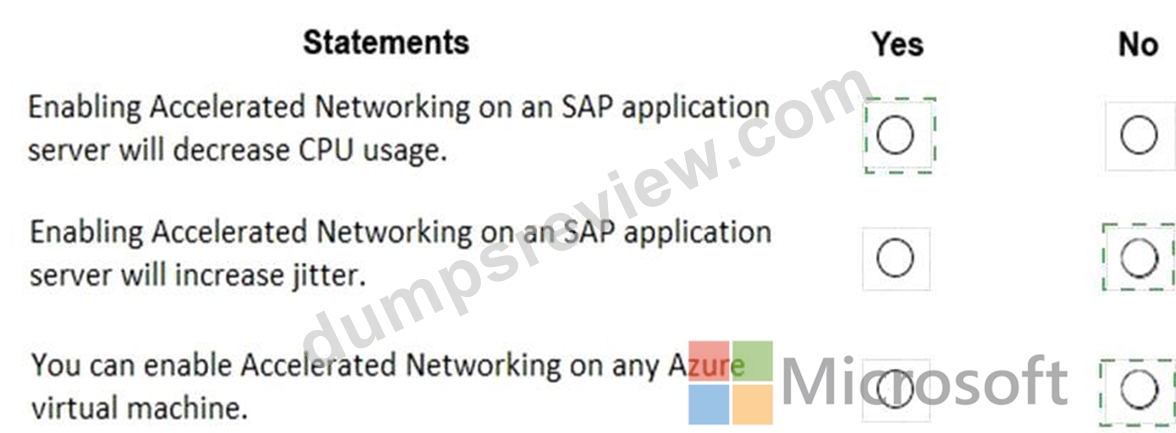
Explanation
Box 1: Yes
By moving much of Azure's software-defined networking stack off the CPUs and into FPGA-based SmartNICs, compute cycles are reclaimed by end user applications, putting less load on the VM, decreasing jitter and inconsistency in latency.
Box 2: NO
Box 3: No
Accelerated Networking (AN) is generally available (GA) and widely available for Windows and the latest distributions of Linux References:
https://azure.microsoft.com/en-us/blog/maximize-your-vm-s-performance-with-accelerated-networking-now-gen
https://azure.microsoft.com/en-gb/blog/maximize-your-vm-s-performance-with-accelerated-networking-now-gen
NEW QUESTION # 74
You have an Azure subscription.
You plan to deploy a highly available SAP NetWeaver system to an Azure region that contains three availability zones. The system will be hosted in an Azure virtual machine scale set.
You need to recommend which type of deployment and which platformFaultDomainCount value to use. The solution must maximize the availability of the system.
What should you recommend? To answer, select the appropriate options in the answer area.
NOTE: Each correct selection is worth one point.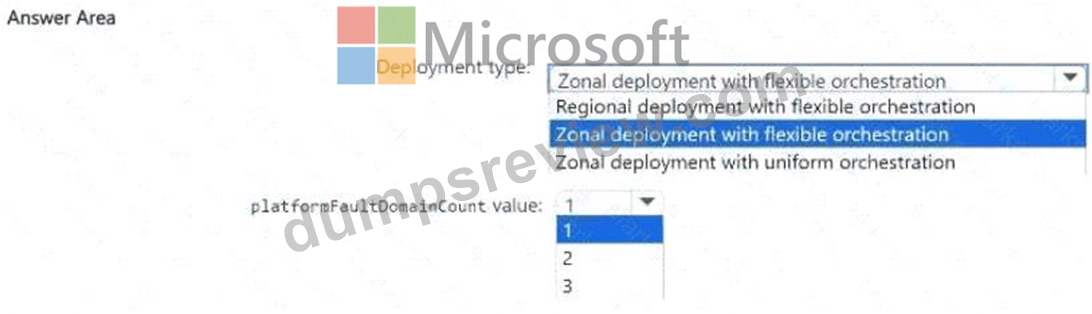
Answer:
Explanation: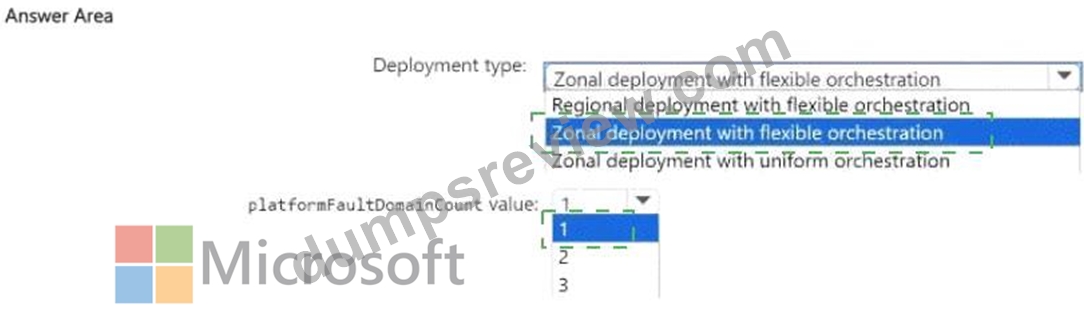
Explanation:
NEW QUESTION # 75
Your on-premises network contains SAP and non-SAP applications. ABAP-based SAP systems are integrated with IDAP and use user name/password-based authentication for logon.
You plan to migrate the SAP applications to Azure.
For each of the following statements, select Yes if the statement is true. Otherwise, select No. NOTE: Each correct selection is worth one point.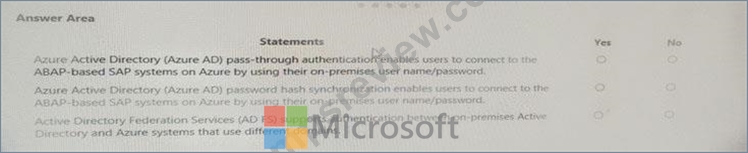
Answer:
Explanation: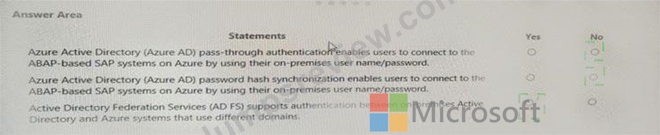
NEW QUESTION # 76
You have an on- premises SAP environment hosted on VMware VSphere that in Microsoft SQL Server as the database platform. You plan to migrate the environment to Azure. The database platform will remain the same.
You need gather information to size the target Azure Environment for the migration. What should you use?
What should you use?
- A. Azure Monitor
- B. the SAP EarlyWatch Alert report
- C. Azure Advisor
- D. the SAP NANA sizing report
Answer: B
Explanation:
Explanation
https://azure.microsoft.com/nl-nl/blog/sap-on-azure-architecture-designing-for-performance-and-scalability/
"For existing on-premises systems, you should reference system configuration and resource utilization data.
The system utilization information is collected by the SAP OS Collector and can be reported via SAP transaction OS07N as well as the EarlyWatch Alert. "
NEW QUESTION # 77
For each of the following statements, select Yes if the statement is true. Otherwise, select No. NOTE: Each correct selection is worth one point.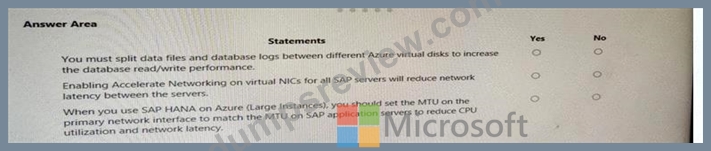
Answer:
Explanation: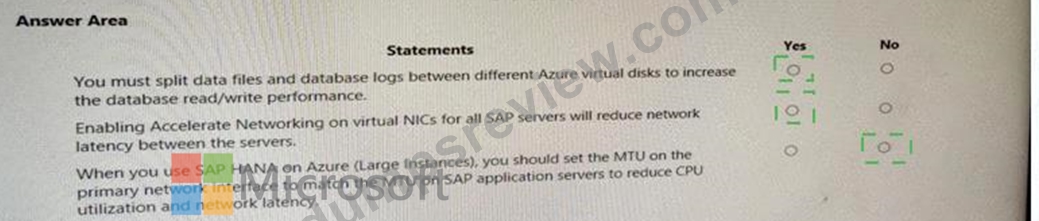
Explanation
Graphical user interface, text, application, email Description automatically generated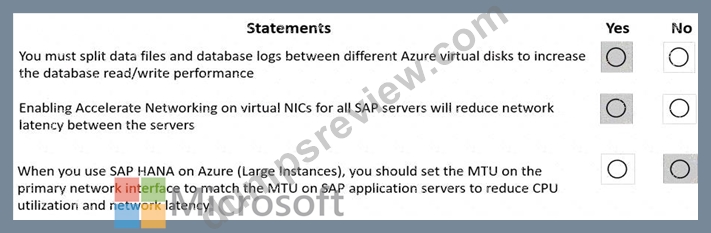
Box 1: Yes
The following is a quick checklist of storage configuration best practices for running your SQL Server on Azure VM:
Place data, log, and tempdb files on separate drives.
Box 2: Yes
Accelerated networking enables single root I/O virtualization (SR-IOV) to a VM, greatly improving its networking performance. This high-performance path bypasses the host from the data path, which reduces latency, jitter, and CPU utilization for the most demanding network workloads on supported VM types.
Box 3: No
Note: The maximum transmission unit (MTU) is the largest size frame (packet), specified in bytes, that can be sent over a network interface. The MTU is a configurable setting. The default MTU used on Azure VMs, and the default setting on most network devices globally, is 1,500 bytes.
Reference:
https://docs.microsoft.com/en-us/azure/virtual-network/create-vm-accelerated-networking-powershell
https://docs.microsoft.com/en-us/azure/azure-sql/virtual-machines/windows/performance-guidelines-best-practic
NEW QUESTION # 78
You are evaluating the migration plan.
Licensing for which SAP product can be affected by changing the size of the virtual machines?
- A. SAP SCM
- B. SAP ECC
- C. PI
- D. SAP Solution Manager
Answer: B
Explanation:
Scenario: Increase the performance of SAP ECC applications by moving to SAP HANA.
References:
https://azure.microsoft.com/en-us/pricing/details/virtual-machines/rhel-sap-hana/ Design an Azure Solution to Support SAP Workloads Question Set 2
NEW QUESTION # 79
You migrate SAP ERP Central Component (SAP ECC) production and non-production landscapes to Azure.
You are licensed for SAP Landscape Management (LaMa).
You need to refresh from the production landscape to the non-production landscape.
Which four actions should you perform in sequence? To answer, move the appropriate actions from the list of actions to the answer area and arrange them in the correct order.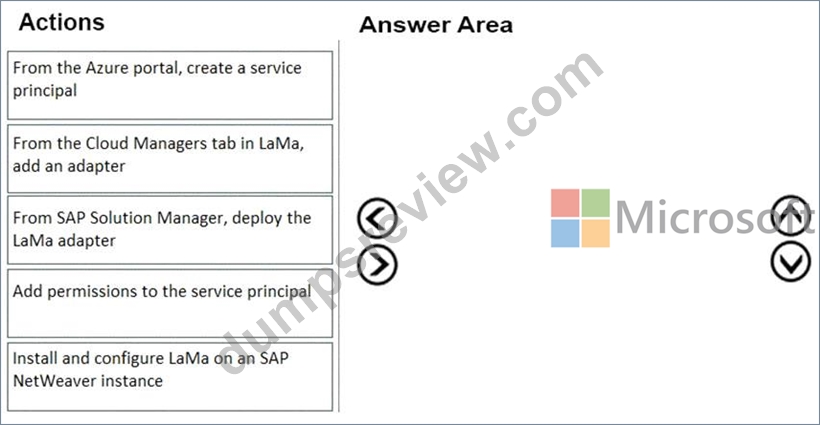
Answer:
Explanation: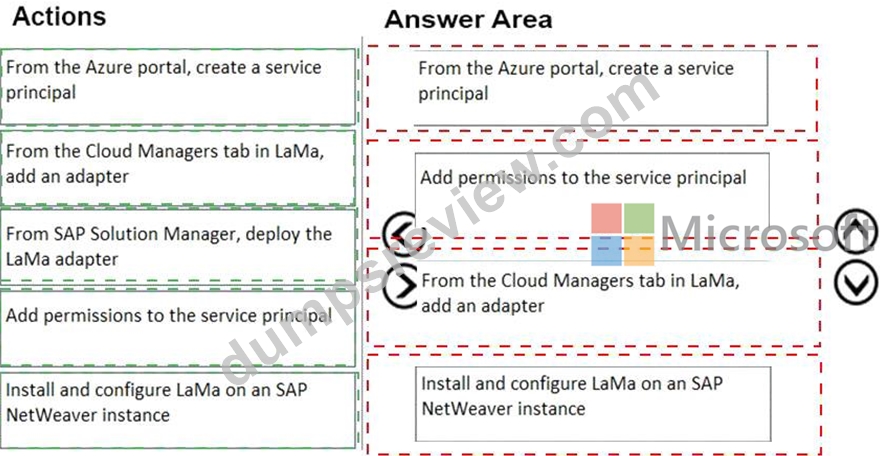
Explanation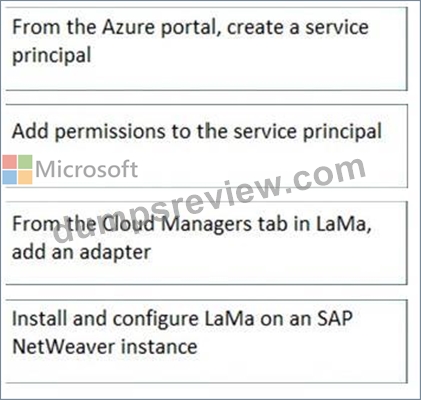
Step 1: From the Azure portal, create a service principal
The Azure connector can use a Service Principal to authorize against Microsoft Azure. Follow these steps to create a Service Principal for SAP Landscape Management (LaMa).
Step 2: Add permissions to the service principal
The Service Principal does not have permissions to access your Azure resources by default. You need to give the Service Principal permissions to access them.
Step 3: From the Cloud Managers tab in LaMa, add an adapter
Create a new connector in SAP LaMa
Open the SAP LaMa website and navigate to Infrastructure. Go to tab Cloud Managers and click on Add.
Select the Microsoft Azure Cloud Adapter
Step 4: Install and configure LaMA on an SAP NetWeater instance
Provision a new adaptive SAP system
You can manually deploy a new virtual machine or use one of the Azure templates in the quickstart repository.
It contains templates for SAP NetWeaver ASCS, SAP NetWeaver application servers, and the database. You can also use these templates to provision new hosts as part of a system copy/clone etc.
Note: To support customers on their journey into a cloud model (hybrid or entirely public cloud), SAP and Microsoft partnered to create an adapter that integrates the SAP management capabilities of LaMa with the IaaS advantages of Microsoft Azure.
References:
https://docs.microsoft.com/en-us/azure/virtual-machines/workloads/sap/lama-installation
https://docs.microsoft.com/en-us/learn/modules/maintain-azure-sap-workloads/2-set-up-remote-management
NEW QUESTION # 80
You have a large and complex SAP environment on Azure.
You are designing a training landscape that will be used 10 times a year.
You need to recommend a solution to create the training landscape. The solution must meet the following requirements:
* Minimize the effort to build the training landscape.
* Minimize costs.
In which order should you recommend the actions be performed for the first training session? To answer, move all actions from the list of actions to the answer area and arrange them in the correct order.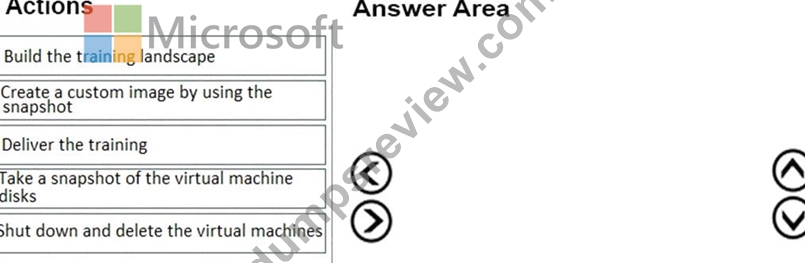
Answer:
Explanation: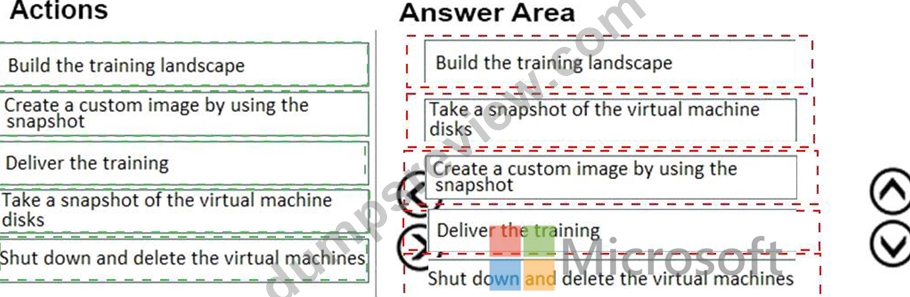
Explanation
Build
Snapshot
Custom Image
Deliver Training
Shutdown
References:
https://docs.microsoft.com/en-us/azure/virtual-machines/workloads/sap/planning-guide
NEW QUESTION # 81
You have an on-premises SAP environment that uses AIX servers and IBM DB2 as the database platform.
You plan to migrate SAP to Azure. In Azure, the SAP workloads will use Windows Server and Microsoft SQL Server as the database platform.
What should you use to export from DB2 and import the data to SQL Server?
- A. SQL Server Management Studio (SSMS)
- B. R3trans
- C. Azure SQL Data Warehouse
- D. R3load
Answer: A
Explanation:
Explanation/Reference:
Explanation:
To migrate DB2 databases to SQL Server, you must connect to the DB2 database that you want to migrate.
When you connect, SSMA obtains metadata about all DB2 schemas, and then displays it in the DB2 Metadata Explorer pane.
References:
https://docs.microsoft.com/en-us/sql/ssma/db2/connecting-to-db2-database-db2tosql?view=sql-server-ver15
https://docs.microsoft.com/en-us/biztalk/adapters-and-accelerators/adapter-sap/import-sap-data-using-sql- server-management-studio
NEW QUESTION # 82
A customer has an on-premises SAP environment.
The customer plans to migrate SAP to Azure.
You need to prepare the environment for the planned migration.
Which three actions should you perform in sequence before the migration? To answer, move the appropriate actions from the list of actions to the answer area and arrange them in the correct order.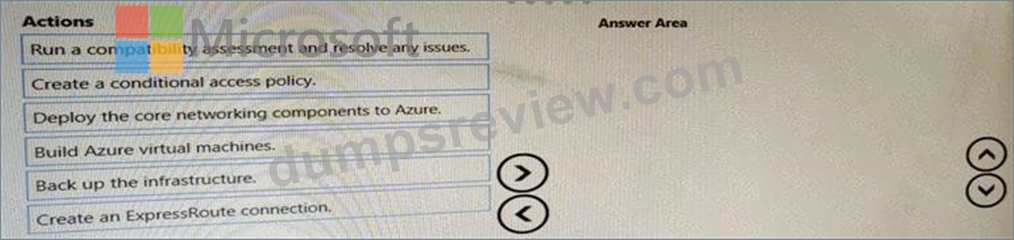
Answer:
Explanation: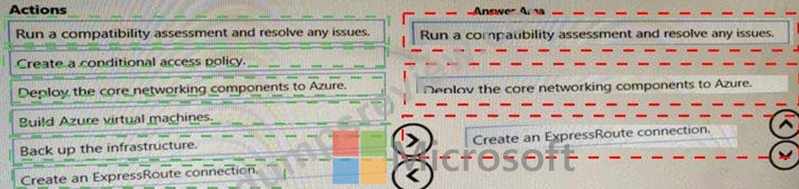
NEW QUESTION # 83
You have an on-premises SAP landscape and a hybrid Microsoft Entra tenant. You plan to enable Microsoft Entra authentication for SAP NetWeaver. What should you configure first in Microsoft Entra ID?
- A. a conditional access policy
- B. a service principal
- C. a Microsoft Entra Application Proxy
- D. a user flow
Answer: C
NEW QUESTION # 84
......
Microsoft Azure Fundamentals-AZ-120 Exam-Practice-Dumps: https://www.dumpsreview.com/AZ-120-exam-dumps-review.html
Use Real AZ-120 Dumps - Microsoft Correct Answers: https://drive.google.com/open?id=1yo1xGbV_1zPtrANYlTvzYlzCOLYHf2Bl
