

[Dec-2025] Exam CRT-450: New Brain Dump Professional - DumpsReview
Free CRT-450 Exam Dumps to Improve Exam Score
Salesforce CRT-450 (Salesforce Certified Platform Developer I) exam is designed for individuals who want to demonstrate their skills in developing custom applications on the Salesforce platform. Salesforce Certified Platform Developer I certification is ideal for developers who have experience in building applications on the Salesforce platform and want to validate their knowledge and skills. CRT-450 exam is designed to test the candidate's ability to design, develop, test, and deploy custom applications on the Salesforce platform using Apex and Visualforce.
NEW QUESTION # 101
What are two benefits of using declarative customizations over code? Choose 2 answers
- A. Declarative customizations automatically generate test classes.
- B. Declarative customizations cannot generate run time errors.
- C. Declarative customizations generally require less maintenance.
- D. Declarative customizations automatically update with each Salesforce release.
Answer: C,D
NEW QUESTION # 102
Which aspect of Apex programming is limited due to multitenancy?
- A. The number of records returned from database queries
- B. The number of records processed in a loop
- C. The number of active Apex classes
- D. The number of methods in an Apex Class
Answer: B
Explanation:
The aspect of Apex programming that is limited due to multitenancy is the number of records processed in a loop. Multitenancy is a means of providing a single application to multiple organizations, such as different companies or departments within a company, from a single hardware-software stack. This results in a standard environment that is fully operated and managed by Salesforce, which is much more efficient and cost-effective for your company. However, multitenancy also imposes some limits and governor rules on the Apex code that runs on the Salesforce Platform, to ensure that no single organization can monopolize the shared resources and affect the performance and reliability of other organizations. One of these limits is the number of records that can be processed in a loop, which is 200 for synchronous Apex and 2000 for asynchronous Apex. This means that if you have a loop that iterates over a collection of records, such as a list or a set, you cannot process more than 200 or 2000 records at a time, depending on the context of your Apex code. If you try to process more records than the limit, you will get a System.LimitException error. To avoid hitting this limit, you need to use best practices such as using SOQL for loops, using collections and maps, using bulkified methods, and using asynchronous Apex.
The other options are not aspects of Apex programming that are limited due to multitenancy. The number of active Apex classes is not limited by multitenancy, but by the total size of all Apex classes in your organization, which is 6 MB for Enterprise Edition and 36 MB for Unlimited Edition. The number of methods in an Apex class is not limited by multitenancy, but by the maximum number of characters in an Apex class, which is 1,000,000. The number of records returned from database queries is not limited by multitenancy, but by the SOQL query row limit, which is 50,000 for synchronous Apex and 200,000 for asynchronous Apex.
References: Apex Governor Limits, Multitenancy and Metadata Overview, Prepare for Your Salesforce Platform Developer I Credential
NEW QUESTION # 103
A software company uses the following objects and relationships:
* Case: to handle customer support issues
* Defect__c: a custom object to represent known issues with the company's software
* Case_Defect__c: a junction object between Case and Defect__c to represent that a defect is a cause of a customer issue Case and Defect__c have Private organization-wide defaults.
What should be done to share a specific Case_Defect__c record with a user?
- A. share the parent Defect__c record.
- B. Share the parent Case record.
- C. Share the Case_Defect_c record.
- D. Share the parent Case and Defect_c records.
Answer: D
Explanation:
Since Case and Defect__c have Private organization-wide defaults (OWD), users need explicit access to the parent records to access the child records in a master-detail or junction object relationship.
The Case_Defect__c is a junction object between Case and Defect__c.
Option C: Share the parent Case and Defect__c records.
Correct Answer.
To access a record on a junction object (Case_Defect__c), a user must have access to both parent records.
Sharing both the Case and Defect__c records with the user will grant them access to the Case_Defect__c record.
Sharing only the Defect__c record is not enough; access to the Case is also required.
Option B: Share the parent Case record.
Insufficient.
Option D: Share the Case_Defect__c record.
*Not Possible Directly.
Sharing rules cannot be applied directly to junction object records in a master-detail relationship.
Access is controlled through the parent records.
Conclusion:
To share a specific Case_Defect__c record with a user, you need to share both the parent Case and Defect__c records, which is Option C.
Reference:
Sharing Considerations for Junction Objects
Sharing Behavior
Incorrect Options:
Option A: Share the parent Defect__c record.
Insufficient.
NEW QUESTION # 104
What actions types should be configured to display a custom success message?
- A. Post a feed item.
- B. Delete a record.
- C. Close a case.
- D. Update a record.
Answer: D
NEW QUESTION # 105
Where can the custom roll-up summary fields be created using Standard Object relationships (Choose 3)
- A. On Account using Case records.
- B. On Opportunity using Opportunity Product records.
- C. On Quote using Order records.
- D. On Account using Opportunity records.
- E. On Campaign using Campaign Member records.
Answer: B,D,E
NEW QUESTION # 106
A developer creates a custom exception as shown below:
public class ParityException extends Exception { }
What are two ways the developer can fire the exception in Apex?
- A. throw new parityException ('parity does not match');
- B. throw new ParityException ();
- C. new ParityException('parity does not match');
- D. new ParityException ();
Answer: A,B
NEW QUESTION # 107
What should a developer use to fix a Lightning web component bug in a sandbox?
- A. Force.com IDE
- B. Developer Console
- C. VS Code
- D. Execute Anonymous
Answer: C
Explanation:
The best tool to use to fix a Lightning web component bug in a sandbox is VS Code with the Salesforce Extension Pack. VS Code is a powerful and popular code editor that supports many languages and features. The Salesforce Extension Pack provides a set of tools and commands to work with Salesforce metadata, such as Lightning web components, Apex classes, Visualforce pages, and more1. Using VS Code, a developer can create, edit, deploy, and retrieve Lightning web components from a sandbox, as well as debug them using breakpoints, watch expressions, and the console2. VS Code also integrates with other tools and services, such as Git, GitHub, Salesforce CLI, and Lightning Web Components Playground3.
The Developer Console is not the best tool to use to fix a Lightning web component bug in a sandbox, as it is mainly designed for working with Apex and Visualforce. The Developer Console does not support creating or editing Lightning web components, nor does it provide debugging features for them4.
The Force.com IDE is not the best tool to use to fix a Lightning web component bug in a sandbox, as it is deprecated and no longer supported by Salesforce. The Force.com IDE was an Eclipse-based IDE that allowed developers to work with Salesforce metadata, but it had limited support for Lightning web components and did not provide debugging features for them5.
The Execute Anonymous tool is not the best tool to use to fix a Lightning web component bug in a sandbox, as it is used to run arbitrary Apex code that is not saved as part of the application. The Execute Anonymous tool does not support creating or editing Lightning web components, nor does it provide debugging features for them6.
References:
* 1: Salesforce Extension Pack for Visual Studio Code
* 2: Debug Your Code | Salesforce DX Developer Guide | Salesforce Developers
* 3: Visual Studio Code Integration | Salesforce DX Developer Guide | Salesforce Developers
* 4: Developer Console | Salesforce Developer Guide | Salesforce Developers
* 5: Force.com IDE | Salesforce Developer Guide | Salesforce Developers
* 6: Execute Anonymous | Apex Developer Guide | Salesforce Developers
NEW QUESTION # 108
When using Salesforce DX, what does a developer need to enable to create and manage scratch orgs?
- A. Production
- B. Dev Hub
- C. Environment Hub
- D. Sandbox
Answer: B
Explanation:
When using Salesforce DX, developers need to enable the Dev Hub in their org to create and manage scratch orgs.
Option A: Dev Hub
Correct Answer.
The Dev Hub is a feature that must be enabled in a Salesforce org (usually in a Developer Edition or a production org).
It allows developers to create and manage scratch orgs using Salesforce DX commands.
Dev Hub is the central point for creating and managing your scratch orgs.
While Dev Hub can be enabled in a production org, simply having a production org is not sufficient. Dev Hub must be explicitly enabled.
Option C: Environment Hub
Incorrect.
The Environment Hub is used to manage multiple orgs but is not required for Salesforce DX scratch orgs.
Option D: Sandbox
Incorrect.
Scratch orgs are not created from sandboxes, and enabling scratch org creation requires Dev Hub.
Conclusion:
To create and manage scratch orgs with Salesforce DX, the developer needs to enable Dev Hub.
Reference:
Enable Dev Hub in Your Org
Salesforce DX Developer Guide
Incorrect Options:
Option B: Production
Incorrect.
NEW QUESTION # 109
A developer is asked to write helper methods that create test data for unit tests.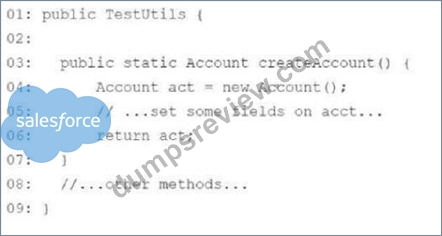
What should be changed in the TestUtils class so that its methods are only usable by unit test methods?
- A. @isTest above line 03.
- B. Remove static from line 03.
- C. Add @istest above line 01.
- D. Change public to private on line 01.
Answer: C
Explanation:
To ensure that the TestUtils class and its methods are only accessible by unit test methods, the class must be annotated with the @isTest annotation. This annotation limits the scope of the class and its methods to test contexts only.
Why @isTest?
Purpose of @isTest:
The @isTest annotation marks a class or method for use exclusively within test scenarios. It prevents the methods from being accidentally invoked in production code.
This ensures better test isolation and prevents misuse.
Static Test Data Methods:
Marking helper methods for test data creation as @isTest ensures they do not interfere with production code and are strictly for testing purposes.
Analysis of Options:
Option A: @isTest above line 03:
Incorrect. Applying @isTest only to the createAccount method would work, but the other methods in the class would still be accessible. This does not satisfy the requirement of restricting the entire class.
Option B: Add @isTest above line 01:
Correct. Annotating the class ensures all methods within the class are accessible only in the context of tests.
Option C: Change public to private on line 01:
Incorrect. Changing the class to private would cause a compilation error, as top-level classes in Salesforce cannot be declared private.
Option D: Remove static from line 03:
Incorrect. Removing static does not affect the test scope of the class or its methods. Static methods can still be invoked, and this does not restrict access to test contexts.
Correct Implementation:
The corrected code would look like this:
@isTest
public class TestUtils {
public static Account createAccount() {
Account acct = new Account();
// Set some fields on acct
return acct;
}
// Other methods...
}
References:
Apex Testing: Test Classes and Methods
Trailhead Module on Apex Testing
NEW QUESTION # 110
What are two ways a developer can get the status of an enquered job for a class that queueable interface? Choose 2 answers
- A. View the apex Jobs page
- B. Query the AsyncApexJobe object
- C. View the apex flex Queue
- D. View the apex status Page
Answer: A,D
NEW QUESTION # 111
Universal Containers wants a list button to display a Visualforce page that allows users to edit multiple records.
Which Visualforce feature supports this requirement?
- A. Standard controller and the recordsetvar page attribute
- B. Standard Controller with Custom List Controller extension
- C. Custom List Controller with recorasetvar page attribute
- D. Controller Extension and <spex:listButton> tag
Answer: A
Explanation:
TherecordSetVarattribute of the<apex:page>tag allows a Visualforce page to handle multiple records, which is ideal for list buttons that display a page for bulk editing.
Why not other options?
A: Standard controllers can be extended, but usingrecordSetVaris the direct and best-supported method for this scenario.
B: There is no such concept as a "Custom List Controller" in Visualforce.
C:<spex:listButton>is not a valid Visualforce tag.
Visualforce Standard Controller with RecordSetVar
NEW QUESTION # 112
What can be used to override the Account's standard Edit button for Lightning Experience?
- A. Lightning component
- B. Lightning action
- C. Lightning page
- D. Lightning flow
Answer: A
NEW QUESTION # 113
How can a developer refer to, or instantiate a PageReference in Apex? Choose 2 answers
- A. By using the ApexPages.Page() method with a Visualforce page name.
- B. By using the PageReference.Page() method with a partial or full URL.
- C. By using the Page object and a Visualforce page name.
- D. By using a PageReference with a partial or full URL.
Answer: C,D
NEW QUESTION # 114 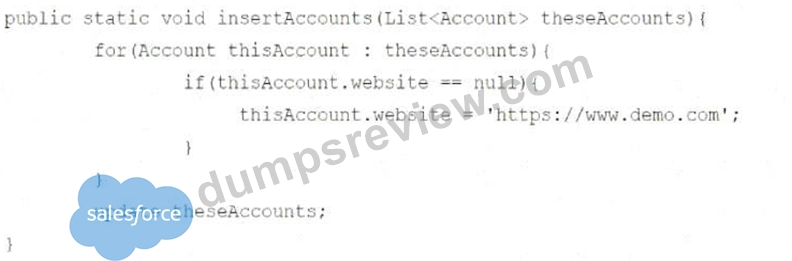
When the code executes, a DML exception is thrown.
How should a developer modify the code to ensure exceptions are handled gracefully?
- A. Implement the upset DML statement.
- B. Implement Change Data Capture.
- C. Remove null items from the list of Accounts.
- D. Implement a try/catch block for the DML.
Answer: D
Explanation:
Why a try/catch block is required:
In Salesforce, DML operations such as insert, update, delete, and upsert can throw exceptions due to issues like validation rule violations, field constraints, or sharing rule restrictions.
Using a try/catch block ensures that these exceptions are caught and handled gracefully, preventing the entire transaction from failing.
How to modify the code:
The update statement in the code can be wrapped in a try/catch block to catch and handle any exceptions that occur. For example:
apex
Copy code
public static void insertAccounts(List<Account> theseAccounts) {
try {
for (Account thisAccount : theseAccounts) {
if (thisAccount.website == null) {
thisAccount.website = 'https://www.demo.com';
}
}
update theseAccounts;
} catch (DmlException e) {
System.debug('DML Exception: ' + e.getMessage());
}
}
Why not the other options?
A). Implement the upsert DML statement:
upsert is used to either insert or update records based on an external ID or primary key. It does not inherently handle exceptions.
B). Implement Change Data Capture:
Change Data Capture (CDC) is used for tracking changes to data in real time and is unrelated to handling DML exceptions.
D). Remove null items from the list of Accounts:
While cleaning the input data is a good practice, it does not address the need for exception handling during DML operations.
References:
Apex Error Handling
DML Operations in Apex
NEW QUESTION # 115
In which three areas can a Lightning component be used in the Lightning Experience? (Choose three.)
- A. Lightning Report page
- B. Lightning Community Page
- C. Lightning Record Page
- D. Lightning Connect page
- E. Lightning Home page
Answer: B,C,E
Explanation:
Explanation
NEW QUESTION # 116
The Job _Application__c custom object has a field that is a master-detail relationship to the Contact object, where the Contact object is the master.
As part of a feature implementation, a developer needs to retrieve a list containing all Contact records where the related Account Industry is
'Technology', while also retrieving the Contact's Job_Application__c records.
Based on the object's relationships, what is the most efficient statement to retrieve the list of Contacts?
- A.

- B.

- C.

- D.

Answer: A
NEW QUESTION # 117
A developer has the controller class below.
Which code block will run successfully in an execute anonymous window?
myFooController m = new myFooController();
- A. System.assert(m.prop ==1);
- B. System.assert(m.prop !=null);
myFooController m = new myFooController(); - C. System.assert(m.prop ==0);
myFooController m = new myFooController(); - D. System.assert(m.prop ==null);
myFooController m = new myFooController();
Answer: D
NEW QUESTION # 118
Universal Containers wants Opportunities to be locked from editing when reaching the Closed/Won stage.
Which two strategies should a developer use to accomplish this? Choose 2 answers
- A. Use a validation rule.
- B. Use a trigger.
Answer: A,B
NEW QUESTION # 119
What should a developer use to script the deployment and unit test execution as part of continuous integration?
- A. VS Code
- B. Salesforce CLI
- C. Developer Console
- D. Execute Anonymous
Answer: B
Explanation:
To script the deployment and unit test execution as part of continuous integration (CI), developers use tools that can be automated and run from the command line or scripts.
Option D: Salesforce CLI
Correct.
The Salesforce CLI (Command-Line Interface) is a powerful command-line tool that allows developers to interact with Salesforce orgs.
It supports scripting of deployments using commands like sfdx force:source:deploy and running unit tests using sfdx force:apex:test:run.
The CLI can be integrated into CI/CD pipelines to automate deployments and testing.
While Visual Studio Code is a powerful IDE for Salesforce development, it is primarily used for interactive development.
It is not a scripting tool and is not suitable for automation in CI/CD pipelines.
The Developer Console is a web-based tool within Salesforce for interactive development and debugging.
It cannot be used for scripting or automation as part of CI/CD processes.
Execute Anonymous is used to run Apex code snippets in an ad-hoc manner.
It is not suitable for scripting deployments or unit test execution in CI/CD.
Reference:
Salesforce CLI Command Reference
Incorrect Options:
Option A: VS Code
Incorrect.
Salesforce Extensions for VS Code
Option B: Developer Console
Incorrect.
Developer Console Overview
Option C: Execute Anonymous
Incorrect.
Executing Anonymous Apex Code
Conclusion:
The correct tool for scripting deployment and unit test execution in CI/CD is Salesforce CLI.
NEW QUESTION # 120
Universal Containers hires a developer to build a custom search page to help user- find the Accounts they want. Users will be able to search on Name, Description, and a custom comments field.
Which consideration should the developer be aware of when deciding between SOQL and SOSL?
Choose 2 answers
- A. SOQL is able to return more records.
- B. SOQL is faster for text searches.
- C. SOSL is faster for tent searches.
- D. SOSL is able to return more records.
Answer: A,C
NEW QUESTION # 121
What are the eight officially supported languages on Heroku platform?
- A. Node,Ruby java,PHP,Python,Go,Scala,Clojure.
- B. Lisp,PHP,Node,Ruby,Scala,Haskell,Go,Erlang.
- C. C#,C++,Node,Ruby,Java,PHP,Go,.Net.
- D. Node,Ruby,java,PHP,Python,.Net,C++.
Answer: A
NEW QUESTION # 122
A developer is asked to create a custom visualforce page that will be used as a dashboard component. Which three are valid controller options for this page? Choose 3 answers
- A. Use a custom controller
- B. Use a custom controller with extensions
- C. Use a standard controller with extensions
- D. Use a standard controller
- E. Do not specify a controller
Answer: A,C,D
NEW QUESTION # 123
A developer has the following requirements:
* Calculate the total amount on an Order.
* Calculate the line amount for each Line Item based on quantity selected and price.
* Move Line Items to a different Order if a Line Item is not in stock.
Which relationship implementation supports these requirements on its own?
- A. Order has a re-parentable lookup field to Line Item.
- B. Line Item has a re-parentable master-detail field to Order.
- C. Line Item has a re-parentable lookup field to Order.
- D. Order has are-parentable master-detail field to Line Item.
Answer: B
NEW QUESTION # 124
......
To be eligible to take the Salesforce CRT-450 Certification Exam, candidates must have a solid understanding of Salesforce concepts, including data modeling and management, security, and user interfaces. Additionally, candidates should have experience with Apex programming and the ability to write code that is efficient, scalable, and maintainable. CRT-450 exam covers a broad range of topics, including data manipulation, SOQL and SOSL, Apex triggers and classes, Visualforce pages and controllers, and Lightning components. Passing the Salesforce CRT-450 exam demonstrates that a developer has a strong foundation in Salesforce development and is capable of building custom applications that meet business requirements.
Salesforce Certified Platform Developer I (CRT-450) certification exam is designed for individuals who want to showcase their skills and knowledge in developing and maintaining custom applications on the Salesforce platform. Salesforce Certified Platform Developer I certification is ideal for developers who have experience with Apex and Visualforce and are looking to enhance their skills to create advanced customizations on the platform.
Powerful CRT-450 PDF Dumps for CRT-450 Questions: https://www.dumpsreview.com/CRT-450-exam-dumps-review.html
2025 Realistic CRT-450 Dumps Exam Tips Test Pdf Exam Material: https://drive.google.com/open?id=1E90ysJxFCQZDqOFr27ZnKxEg_Y8Sla7q
